|
|
Past News Reports - 2002
Please Note: All links to external web pages (i.e. Not within this site) will be opened up in a new Browser Window on top of the Christopher Reeve Homepage. Once you've finished reading the external web page, all you need to do is close that Browser Window and the Christopher Reeve Homepage will still be there.
2002
- January 11, 2002: An article in The Wall Street Journal about President Bush's yet to be named members of the Council on Bioethics, which is scheduled to begin meeting next week, reported that Christopher Reeve, an advocate of the controversial embryonic stem cell research and cloning for medical research purposes, "wants to serve but hasn't been asked."
- January 16, 2002: Today President Bush named 17 leading scientists, doctors, ethicists, social scientists, lawyers, and theologians to serve on the President's Council on Bioethics. The Council will be chaired by Dr. Leon Kass, a prominent bioethicist from the University of Chicago who was previously named. Christopher Reeve, who has a personal emotional interest in research is not a doctor, scientist or professor in bioscience ethics, apparently had representatives unsuccessfully press the White House to include him in the panel to represent patients. Reeve's special interest group CAMR released this statement from Michael Manganiello, who is President of CAMR and assistant to Reeve: "We are very concerned that the list of council members does not have patient group representatives. Dr. Kass has promised the council will transcend politics and uphold its mission to study the issues thoroughly and work with the President to present its findings. But it is imperative that the therapeutic needs of 100 million Americans living with diseases and life-threatening conditions, who could potentially benefit from embryonic stem cell research and somatic cell nuclear transfer, are considered in these discussions. The voices of patients are critical in the mix of viewpoints that are shaping public policies of such great importance." The Council will keep the President and our nation apprised of new developments and provide a forum for discussion and evaluation of these profound issues. The Council will consider a range of bioethical matters connected with specific biomedical and technological activities, such as embryo and stem cell research, assisted reproduction, cloning, uses of knowledge and techniques derived from human genetics or the neurosciences, and end-of-life issues. The Council's paramount objective will be to develop a deep understanding of the issues that it considers and to advise the President of the complex and often competing moral positions associated with biomedical innovation. The White House press release also says, "The President has assembled a diverse group of individuals to address these matters, who will bring a variety of perspectives to these challenging issues. Council members have been chosen not only for their specialized knowledge, but also for their thoughtfulness and their devotion to serious ethical inquiry. With their assistance and guidance, the President will continue to forge a policy on bioethical issues that reflects his strong support of science and technology, as well as his deep respect for human life and human dignity."
- January 19, 2002: The New York Rangers hosted their fourth annual charity hockey event SuperSkate 2002 at Madison Square Garden to benefit Rangers Cheering For Children and the Christopher Reeve Paralysis Foundation (CRPF). An assistant to the Christopher Reeve Homepage was lucky enough to attend the event. The event started with two short documentaries on the charities which the event was raising money for. CRPF's message in their documentary was, 'We Must, We Can, We Will'. The events got under way with the Superskills competition. Also participating in the skills portion of the evening were youth hockey players from the greater metropolitan area, including Christopher and Dana's son, Will Reeve, as well as members of New York City's Police, Port Authority and Fire Departments. The Superskills competition included testing the players puck control, fastest skating, hardest shot, accuracy shooting, and breakaway relay. When interviewed Will Reeve said that he enjoyed "Every single one" of the skills events he took part in. The results of the competition can be seen by clicking here. The participating celebrity players were as follows: Chris Jericho (WWF's Y2J), Tyler Stewart (Barenaked Ladies), Rick Moranis, Matthew Modine, Tim Robbins, Denis Leary, Chad Lowe, Marcus Schenkenberg (Model), John McEnroe, Gary Dell'Abate (Howard Stern Show), Barry Melrose, John Saunders, Steve Levy (ESPN), Kenny Albert, Gary Dell'Abate (Howard Stern Show), Steve Harris (The Practice), Scott Wolf, Denise Quinones (Miss Universe), Ed Cibrian, Sid Rosenberg (WFAN), Cameron Mathison, and Daniella Pestova (Model); NY Rangers Alumni were: Rod Gilbert, Jeff Beukeboom, Glenn Anderson, and Ted Irvine; Coaches for the teams were: Susan Sarandon and Billy Baldwin. Dana Reeve was joined on the ice by members of the Marines, whilst she sang the National Anthem and got one of the biggest cheers of the night. There was added drama when Chris Jericho decided to pick a 'fight' with an opposing team player, which ultimately resulted in nearly every single player 'fighting' another. Coaches Susan Sarandon and Billy Baldwin were no doubt unimpressed by the players behaviour at this point! The game ended with a 5-5 draw and a penalty shoot out, which the white team won. The nights entertainement ended with the event captains Mark Messier and Christopher Reeve handed out the MVP presentation. Reeve's speech was short but emotional. Amongst the cheering from the crowd he said, "I thank everybody from the bottom of my heart for coming." Rangers Cheering for Children (formerly known as NYR S.K.A.T.E), is a division of the Madison Square Garden's Cheering for Children Foundation, which was established in 1998 in order to make a significant and meaningful impact on the New York community. The primary focus of Rangers Cheering for Children is to strengthen the educational, athletic, artistic and social opportunities in after-school programs for more than 30,000 children in New York's five boroughs.
- February 1, 2002: Christopher Reeve will be among those attending this year's BookExpo America May 2 through 5 at New York's Jacob Javits Convention Center. Others planning to go to the publishing industry's annual national convention to promote new books include former Vice President Al Gore, Queen Noor of Jordan, Rudolph Giuliani, actor John Lithgow, playwright Tony Kushner, and novelists Pat Conroy, Jean Auel and Walter Mosley.
- February 2, 2002: At the Arrowhead Pond, Christopher Reeve, the U.S. military and public-safety workers were cheered by 5,000 people in a patriotic salute. The honorees were celebrated for their courage and community service, and as role models for the seventh annual Front & Center gala, which raises scholarship money for California State University in Fullerton. Reeve represented both the Christopher Reeve Paralysis Foundation and The Reeve-Irvine Research Center at the University of California in Irvine. Reeve was given an award that says he has become "a symbol of towering strength to those who ask for more medical research and more accessibility for disabled people." The six previous Front & Center galas collectively raised more than $1 million in scholarship money and honored such figures as Colin Powell, Michael Eisner and Tony Bennett. Reeve also shared the stage with Marines from Camp Pendleton, which has sent thousands of men and women overseas to support the war in Afghanistan. Among those at the dinner gala, was Marilyn Powell Bern who is the sister of Secretary of State Colin Powell. Comedian Bob Newhart was the evening's emcee, and alumna Dana Meller of Les Miserables performed. The event also honored Henry Nicholas III, president and chief executive officer of Broadcom Corp., who received the Orange County Titan Award.
- February 6, 2002: Ford Motor Company announced in a press release that Christopher Reeve will be featured in a complimentary promotional video for their Mobility Motoring program available by filling out this form. The video titled "I'll See You On The Road": A Film About The Ford Mobility Motoring Program explains how the Ford Mobility Motoring program improves mobility for customers with disabilities and introduces real people who are already experiencing the independence gained by driving or transporting someone in a Ford vehicle with adaptive equipment. In the 23 minute video hosted by Reeve, he says: "If your body doesn't move itself, the next best thing is to take it places, and that means getting out into the community and living as normal a life as possible. Ford has made a real commitment to people with disabilities and their Mobility Motoring Program. I believe that every person with a physical disability can play the hand they've been dealt in the game of life. Ford Mobility Motoring can help make the game more interesting and rewarding and a lot more fun." According to the press release, the program provides up to $1,000 toward the cost of adaptive equipment or up to $200 on alerting devices, lumbar support or running boards when installed on a new Ford, Mercury or Lincoln vehicle. In addition to financial aid, Ford Mobility Motoring provides customers with a state-specific packet of information listing assessment centers, equipment installers and other potential sources for financial assistance, including extended terms through Ford Credit Mobility Financing.
- February 10, 2002: In a surprise Saturday night visit to an American Business Clubs banquet in Grand Rapids, Michigan, Christopher Reeve spoke on the importance of improving the quality of life for people with disabilities. "While we look for a cure, we really want to help people living in the here and now," he said. "It's really our responsibility to think, 'What if it was me in that wheelchair, wouldn't I want the best?'" Reeve said he didn't know where to go, or what to do when he first became paralyzed. He was given a manual detailing spinal cord injuries, but injuries as severe as his were not even listed. So he pushed for the manual to be updated, and now others like him have the information they need. Reeve said he is currently battling the insurance companies and recalled a personal experience he had when he tried to get his insurance company to pay for a backup ventilator, to be used if his broke down. "It was $3,500, and they wouldn't pay," Reeve said. "I'm lucky I could afford $3,500." Reeve said the insurance companies deny claims because few people challenge them. "Thirty percent fight back, 70 percent roll over," he said. "I believe that we're on the verge of being able to convince insurance companies that it is in their best interest to give us proactive care. Reeve explained that insurance companies will save money when expensive equipment and medical care is no longer needed by patients who are rehabilitated out of wheelchairs. After he realized how his life had changed, Reeve decided to use his fame to shine light on these issues and help others. "When I got out of rehab... I realized I had an opportunity," he said. "I didn't anticipate what the reaction would be, but it's been absolutely overwhelming. Very few at the AMBUCS event knew Reeve would be speaking. "It's more than we could ever dream," said Barb Driy, chairwoman of the event. "He's everything we believe in." The AMBUCS mission is to create independence for people with disabilities.
- February 10, 2002: A black-tie gala dinner will be held at 9pm Friday, February 15th at the Stamford Marriott in Connecticutt for the third annual Director's View Film Festival. Christopher Reeve and Margot Kidder, stars of "Superman: The Movie" will present the Joseph L. Mankiewicz Excellence in Film Award to Richard Donner, director of "Superman", "Lethal Weapon", "The Omen", "Ladyhawke" and numerous other films. Tickets are $500.
- February 11, 2002: The Christopher Reeve Paralysis Foundation announces in a press release an update on The Gift Horse, a product fundraiser they are the recipient of that was launched in August 2000. The brief update states: "Cosmetic company philosophy¨ donates all proceeds from its nail strengthener, named The Gift Horse, to the Christopher Reeve Paralysis Foundation. Since it began this program, philosophy¨ has given CRPF over $100,000. Combining business sense and charitable giving, philosophy¨ founder Cristina Carlino is not only a friend to CRPF, but also an inspiration." The Gift Horse is available online for $20.00 for a 0.5 ounce bottle through Philosophy.
- February 12, 2002: Among the advance praise for the new book Alpine Achievement: A Chronicle of the United States Disabled Ski Team published by Creative Communications, Christopher Reeve gushed "Lori Batcheller's Alpine Achievement is both an enjoyable read and comprehensive resource for anyone with an interest in disabled alpine skiing. From stories of the athletes' adjustment to their disability to their experience training for and skiing with the USDST to the historical perspective of the sport, this book covers it all." According the the publisher's press release, the book is the true story of one of the most remarkable teams of athletes to conquer the slopes and is the first book to offer a detailed and powerful account of disabled alpine skiing by chronicling the sport from its inception to its modern day competitions. The book also serves as a comprehensive reference tool, detailing the evolution of adaptive equipment, the history of the sport, scoring, and classification of athletes and also contains several appendices, allowing ski enthusiasts, rehab professionals, people with disabilities, and anyone interested in supporting disabled skiing to find ski areas, equipment manufacturers, and resources that will aide their interests. Olympian Picabo Street wrote the foreword.
- February 12, 2002: Christopher Reeve will participate in a panel discussion on stem cells and human cloning issues on February 20 at the Waldorf-Astoria in New York as part of the Biotechnology Industry Organization's CEO & Investor Conference 2002. The panel, titled Cloning and Stem Cells: Public Policy and the Promise of Regenerative Medicine , will address the therapeutic potential of these techniques, the public policy issues surrounding the field, and how legislation pending in Congress would affect the companies developing stem cell technologies. Also appearing on the panel will be former U.S. Senator Connie Mack (R- Fla.); Carl B. Feldbaum, president of BIO (which represents more than 1,000 biotechnology companies, academic institutions, state biotechnology centers and related organizations in all 50 U.S. states and 33 other nations); and others from that field. The U.S. Senate is currently debating legislation that would prohibit human reproductive cloning but would allow the use of somatic cell nuclear transfer to create highly adaptive stem cells -- a process often called therapeutic cloning. That position was endorsed last month by a National Academy of Sciences report. The Senate is also considering a complete cloning ban similar to one passed last summer by the House of Representatives. President Bush has expressed support for such a ban, which would criminalize both reproductive and therapeutic applications of cloning.
- February 12, 2002: A lengthy progress message from Christopher Reeve was distributed through the Christopher Reeve Paralysis Foundation for fundraising purposes. In the message Reeve expressed disappointment in not being able to reach his goal of standing to make a toast on his 50th birthday this year, touted his political accomplishments and mentioned an upcoming paralysis center the U.S. government is opening through a non-competitive cooperative agreement between the Centers For Disease Control and Prevention and CRPF. Reeve wrote: "This year is special for me, because I turn 50 on September 25th. On several occasions during the years following my accident, I announced that I hoped I would be on my feet by my 50th birthday. Unfortunately, it now seems unlikely that I will meet that deadline. I'm still optimistic that I will walk again, however, and sooner rather than later. And I don't believe my optimism is unfounded. Here's why: in the six years since my injury... ...the research budget of the National Institute of Health has grown from 12 billion in 1998 to just under 25 billion in 2002... ...more young post-docs are choosing the field of spinal cord injury research for their career than ever before... ...the Christopher Reeve Paralysis Foundation has tripled its budget... ...we've dramatically increased funding to the laboratories of the Research Consortium on Spinal Cord Injury... ...we've awarded over $2 million in Quality of Life grants... ...and we've even opened our own core laboratories. And 2002 may prove to be our best year to date. For example, CRPF will award $10 million in research grants this year. That's far more money than we have ever been able to devote to spinal cord injury research in a single year. Equally exciting, CRPF expects to award more than $1.2 million in Quality of Life grants in 2002. The Quality of Life grants support organizations that improve the quality of life of people living with the pain, confusion and frustration that often accompanies a spinal cord injury. Both of these ongoing efforts will get a major boost this spring with the launch of the Christopher and Dana Reeve Paralysis Resource Center. The Paralysis Resource Center will provide the information and assistance that people living with paralysis, and their caregivers, need to get back out into a world that seems so different since their injury. Learning to live with paralysis is a tremendous adjustment, but now there is every reason to believe it'll be a temporary one. Human trials for effective therapies are already in the planning stages or actually underway. The motto of the Foundation is alive and well: We must. We can. We will."
- February 14, 2002: The President's Council on Bioethics held their second meeting at the Loews L'Enfant Plaza Hotel in Washington D.C. and at the end held a public comments session where Tricia Brooks of the Christopher Reeve Paralysis Foundation, and member of CAMR, came to press the Council to consider patients and also seemingly, without using his name, indirectly push to get Christopher Reeve to testify before them in another public comments session. Brooks said, "I want to take a moment to thank you all for your consideration of the patients in this past discussion. It was very heartening to hear you have that discussion. However, none of you are here representing the patient and we certainly appeal to the Council to take a moment and considering having a panel at your next meeting that is representative of the patients because there a lot of voices out here. They are not morally vacuous. They are not without thought or consideration of what the research entails. They are not with an unrealistic point of view of when a therapy will be made available." Earlier in the discussion, Professor Mary Ann Glendon on the Council said about patients being on the Council, "At our last meeting in the public session someone made the comment that there is no representative of patients on this Council and I think it is very important to state publicly and for the record that all of us are patients, potential patients, friends and relatives of patients, many of us treat patients, and so I would like most emphatically to say that representation of patients does not require the presence of a paid lobbyist on the Council but it does require the presence of people who are interested in and sympathetic to patients." Dr. Charles Krauthammer of the Council later added, "Or owe to the patient. Well, as it happens, I am one of those patients...I have a very obvious connection with this issue and I am one of those in whose name people have spoken and said this research has to be permitted so that I can walk or people like me can walk. Spinal cord injuries are always on the list so I am acutely aware of this issue but I am not only a patient. I am also a father...and I think we ought to say to other people who suffer from similar problems and disabilities, is that we have children and we want to raise them in a world that we want to bequeath to them a world, a moral universe, in which we think they ought to live and that we may be jeopardizing the moral quality of that universe, the humanity of that universe by cavalierly breaking moral rules that we have observed for generations in order that people like me can walk. So I think there is a serious moral issue here and I think the assumption that all that people who suffer from disabilities want is a cure at all costs is a misreading of their own humanity."
- February 22, 2002: The Christopher Reeve Homepage caught up with June Fox, who is helping Chris write his new book "Nothing Is Impossible". Here's June's comments on the progress of the book, what we can expect from it, and Christopher's health and state of mind... "Work on the book is going great. It is about 1/3 written. We work together twice a week. We will be finishing up the writing in April or May, I am guessing the book will be out in September or October. Some of the topics Chris has covered are Humor, Mind/Body, and Spirituality. Chris is in great spirits, except for his frustrations about the politics surrounding stem cell research. His sense of humor is very much in evidence, and he is in excellent health."
- February 24, 2002: In an interview with London's The Daily Telegraph, Christopher Reeve said that he would go to the UK "in a heartbeat" if a therapy became available there that is banned in the US. According to Reeve: "The promise of stem cell research is virtually unlimited and the consequences would be devastating if America said no to this technology." Parliament approved the research in the UK last year, but a House of Lords select committee is to pronounce on the matter next week and is under pressure by pro-life groups to oppose that decision. Reeve will be making a speech to the US Senate on the issue next month and argues his case on a Radio Five Live documentary Whose Life Is It Anyway? this evening at 7.35pm. Reeve said that he did not understand the objection to using embryos that would otherwise be discarded by fertility clinics, or embryos that had been created by cloning techniques using DNA from adult cells, and which were "not life as we have known it". "Time is of the essence." he adds. "Every day in a wheelchair is difficult not only for me but for people in worse condition than I am. If this work does not go ahead it will be a death sentence for many and prolong the suffering of millions."
- February 27, 2002: A statement from Christopher Reeve was released through the Christopher Reeve Paralysis Foundation (CRPF) about the House of Lords, of England, decision on human embryonic stem cell research. The statement reads: "On behalf of the Christopher Reeve Paralysis Foundation, I applaud the House of Lords Select Committee decision to allow scientists to conduct research using stem cells derived from cloned human embryos in the earliest stage of development. While politically complicated, the medical, moral and scientific case for this decision is overwhelming. Therapeutic cloning and embryonic stem cell research may represent the best hope for the hundreds of millions worldwide who suffer from Alzheimer's, Parkinson's, diabetes, ALS, Multiple Sclerosis, stroke, spinal cord injury, and many other diseases and disorders. It is my hope that this day marks the beginning of an accelerated period of scientific progress that will lead to new treatments and cures for these dreaded afflictions." CRPF and recognizes the good work being done in the U.K. by the International Spinal Research Trust (ISRT). CRPF and ISRT are both members of the International Campaign for Cures of Spinal Cord Injury Paralysis and are dedicated to supporting effective treatments and cures for paralysis. On February 13th the House of Lords printed their Stem Cell Research Report concluding "...until recently most research on stem cells has focussed on ES cells from animals and the derivation of ES cell lines from them; cell lines from human ES cells have the potential to provide a basis for a wide range of therapies; recent research on adult stem cells, including stem cells from the placenta and umbilical cord, also holds promise of therapies; and research on them should be strongly encouraged by funding bodies and the Government; to ensure maximum medical benefit it is necessary to keep both routes to therapy open at present since neither alone is likely to meet all therapeutic needs; for the full therapeutic potential of stem cells, both adult and ES, to be realised, fundamental research on ES cells is necessary, particularly to understand the processes of cell differentiation and dedifferentiation; future developments might eventually make further research on ES cells unnecessary. This is unlikely in the foreseeable future; in the meantime there is a strong scientific and medical case for continued research on human ES cells."
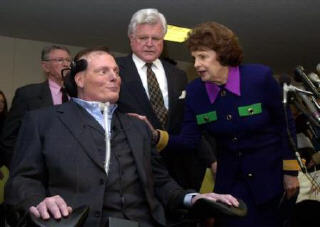
- March 5, 2002: Prior to the Senate hearing by the Committee on Health, Education, Labor and Pensions began on the subject of "The Dangers of Cloning and the Promise of Regenerative Medicine", Christopher Reeve participated in a press conference with Senators Ted Kennedy (D-MA), James Jeffords (I-VT) and Dianne Feinstein (D-CA) to endorse their bill S 1758 "Human Cloning Prohibition Act of 2001" that would outlaw so-called "reproductive cloning", but through a loophole allow so-called "therapeutic cloning". Reeve, in addition to supporting this bill he opposed Senators Sam Brownback (R-KS) and Mary Landrieu's (D-LA) bipartisan bill S 1899 "Human Cloning Prohibition Act of 2001", and was also touting a research his foundation is funding that involves somatic cell nuclear transfer (SCNT) which uses the nucleus of a cell inserted into an egg to form an embryo solely created to collect the stem cells from. At the press conference Reeve said, "I'm here today because I'm very concerned we're about to snatch defeat from the jaws of victory." Reeve added, "It is amazing to me that we have to be here today, because it's so clear that embryonic stem cells ... are a miracle that could be available to us, yet there's a fear factor in this country that's really very disturbing to watch." SCNT or "therapeutic cloning" is commonly mistakenly portrayed to be the same thing as embryonic stem cell research when they are two different areas of experimenting that involve using human embryos. Both are controversial.
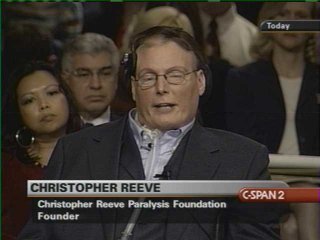
- March 5, 2002: "For the last 7 years, I have not been able to eat, wash, go to the bathroom, or get dressed by myself. Some people are able to accept living with a severe disability. I am not one of them," said Christopher Reeve as he began his testimony (televised on C-SPAN2) at a Senate Health committee hearing on human cloning, "and that is why I have a keen interest in research and am deeply disturbed by unreasonable attempts to block scientific progress." Reeve told the committee, "If we don't make this research legal, if we don't use government funding and oversight, it will happen privately, dangerously, unregulated and uncontrolled." A vote is expected in the spring and "Right now, the balance in the Senate is very, very much in doubt," said Sen. Arlen Specter (R-Pa.), who supports cloning for disease research, sometimes called therapeutic cloning. The vision for this type of cloning, which at best is years away from reality, is to clone a patient and dissect the resulting embryo at about five days for its stem cells. The stem cells, in turn, would theoretically be grown into new heart, brain or insulin-producing cells--whatever that patient needs. Made this way, the cells would match the patient's genetic makeup and would presumably be readily incorporated into the patient's body. By contrast, transplants are currently hampered by tissue rejection, in which the patient's body treats new tissue as foreign material to be expelled. Reeve noted that other countries, including Sweden, Israel and England, are moving ahead with the research. "They're no less moral than we are," Reeve said. "They are not rogue nations."
U.S. Senator Bill Frist (R-TN), the trusted Senate authority on medical matters who is the only practicing heart surgeon in the chamber, concluded that he was "extremely concerned about the research. "We have an obligation to make sure scientific progress does not occur in a moral vacuum," he said. He also seemed to chide scientists by saying it is important to "be honest about the prospects of research, and avoid the temptation to embellish the potential for future cures that may never materialize." An aide confirmed the senator is close to supporting a ban, introduced by Sen. Sam Brownback (R-Kan.). But Frist also expressed discomfort with the part of the bill that would outlaw the importation of treatments made abroad from cloned embryos.
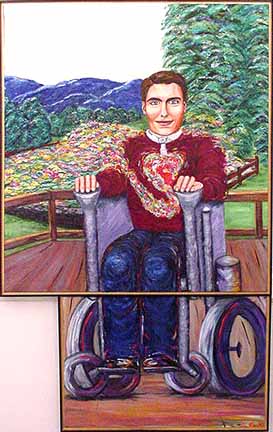
- March 12, 2002: Winchester, Virginia artist Cynthia Fraula-Hahn was granted permission by Christopher Reeve to use his image in a painting entitled, Superman in his Stem Cell Garden, in the upcoming exhibit, Lot 24: The Wheelchair Project, an issue-oriented exhibition. The exhibit will feature issue-oriented studio paintings, collaborative paintings, sculpture and a video performance piece by Fraula-Hahn. It will focus on the human spirit and how the physically challenged overcome the difficulties of daily living in a wheelchair. The exhibition will be hung at wheelchair level with wheelchairs available for non-handicapped individuals who wish to experience the exhibit from that perspective. The painting will include morbid stem cell images incorporated with the figure of Reeve, proudly wearing a stem cell "S" on his chest for either "Superman" or "Stem Cells", with documentation accompanying the painting about the Christopher Reeve Paralysis Foundation. In addition to Reeve, the exhibit includes portraits of artist Frida Kahlo in her wheelchair with her doctor and President Franklin D. Roosevelt. Also included in the exhibit are collaborative paintings created by Fraula-Hahn and artist Alix Tobey Southwick, as well as wheelchair light sculptures and a video created by Fraula-Hahn and environmental lighting specialist Paul Deeb, co-owner of Winchester-based Ear Food Image, Sound and Light. Fraula-Hahn is a southern, feminist painter who, after returning to her roots in Virginia, examined her Quaker heritage and visually recreated a series about life in the South. Her work and attention has now shifted to a larger concept of using the visual arts to raise awareness of the wheelchair-bound segment of our society. The exhibition opens Saturday, April 6 and runs through May 14, 2002, at Shenandoah University's Health Professions Building on the campus of the Winchester Medical Center. Lot 24: The Wheelchair Project will travel after its run at Shenandoah University.
- March 16, 2002: Sunday night at 7.30pm in Australia, Channel 9 will air the Australian TV program "Sixty Minutes" which will feature a special story on Stem Cell Research. Here's how Channel 9 describes this report: "Stem cell research is leading to perhaps the greatest medical breakthroughs of all time. It offers hope that soon Parkinson's disease, diabetes, Alzheimer's - virtually any disease - might be cured. Imagine a world where paraplegics could walk and the blind could see. But it's a breakthrough some passionately oppose - a breakthrough that's caused a fierce and personal debate between those, like Christopher Reeve, who see this technology as a miracle, and those who regard it as murder. Tara Brown presents this special investigation into the stark choice we now confront: embrace it or ban it."
Visit the NineMSN "Sixty Minutes" website featuring a short video clip of this report, which includes an interview with Christopher Reeve.
- March 17, 2002: In the Australian 60 Minutes television news show, Christopher Reeve was interviewed in a piece titled Miracle or Murder? about embryonic stem cell research and the debate surrounding it. Reeve said, "I mean, the idea that we have cells that can become any tissue or any cell type in the body is truly a miracle and, you know, to let it go to waste would be absolutely a crime." In reference to people who opposed the use of embryos Reeve said, "Well, there are the lunatic fringe all over the world. I know I'm being a little disrespectful but I have a hard time buying into that. I simply, you know, if they want to go that way and say that they don't want to be cured, then just step aside, because I am not happy spending my life in a wheelchair. It's unacceptable. I've already been here seven years and that's plenty. So, everybody's got, you know, to believe what they want to believe, just the people who don't want to be cured just please step aside."
- March 19, 2002: A lengthy statement from Christopher Reeve was released through the Christopher Reeve Paralysis Foundation in response to a letter being sent to President Bush today calling for a moratorium on therapeutic cloning by the World Institute on Disability and the American Association of People with Disabilities. The statement reads: "I am opposed to reproductive cloning as well as eugenics, the practice of hereditary improvement of the human race by controlled selective breeding. I support scientific research using nucleus transplantation, often referred to as therapeutic cloning. The Christopher Reeve Paralysis FoundationÕs two-fold mission is to fund cutting-edge medical research and to improve the quality of life of people with disabilities. At the same time, groups such as the National Organization on Disability and the American Association for People with Disabilities work daily to secure the rights of the disabled. I am honored to serve as vice-chairman of the National Organization on Disability. The pursuit of scientific medical research and the pursuit of equal rights for people with disabilities are not mutually exclusive and should continue simultaneously. The Christopher Reeve Paralysis FoundationÕs quest to find therapies and cures for paralysis will help those who are disabled like me, as well as those afflicted with disease. A moratorium or ban on therapeutic cloning would slam the door on promising research that could ease the suffering of millions. Until there is a cure, caring today for people with disabilities remains a priority of the Christopher Reeve Paralysis Foundation. By awarding bi-annual grants, we seek to improve opportunities, access and the day-to-day quality of life for individuals and their families living with disabilities - primarily paralysis. To date we have given more than $2 million to organizations dedicated to providing services needed by the disabled. And, on May 1, 2002, the Christopher Reeve Paralysis Foundation will open a new Paralysis Resource Center. The center will provide a comprehensive library, website, educational materials, referral services, and self-help information for those who live with paralysis, their families and caregivers."
- March 19, 2002: A new public service announcement (PSA) was sent to television stations throughout the United States by the National Organization on Disability (N.O.D.) to combat negative stereotypes of people with disabilities. The PSA features N.O.D. Vice Chairman Christopher Reeve among other celebrities with and without disabilities including Angela Bassett, Harrison Ford, Wyclef Jean, Camryn Manheim, John Stewart, and Stevie Wonder to reflect on both something they cannot do-a different thing for each person, and more importantly what they can do. Reeve says in the PSA, "No matter who you are, there are some things you can do, and some things you can't. I am proud to appear in this PSA, which will educate Americans about the potential that all people with disabilities have." Reeve also concludes it with this: "It's about ability, not disability." The N.O.D. PSA was underwritten by four sponsors: Microsoft; the Presidential Task Force on the Employment of Adults with Disabilities; the McGraw-Hill Companies; and American Express. The film was created by associates of N.O.D. with final editing assistance by the advertising firm Foote Cone & Belding.
- March 20, 2002: The Age, an Australian newspaper, reports that New South Wales Premier Bob Carr wrote to Christopher Reeve, after hearing Reeve speak in support of embryonic stem cell research, asking him to join the NSW government in its campaign to have the research allowed in Australia. In an interview on Channel Nine, Reeve urged the Australian government to make the "correct decision" in relation to stem cell research. "I particularly applaud the efforts of the leaders in NSW who want to do it right and have had the courage to come and speak about what they think the government should do," he said. "So my hat's off to them and I do hope that the Australian government will make the correct decision." Carr immediately wrote to Reeve, to enlist his support in the government's campaign. "Together with you, I believe that embryonic stem cell research has the potential to achieve a cure for spinal injury, cancer, diabetes, Alzheimer's ...." he said. Carr also issued a personal invite to Reeve to visit Sydney with his family. The Australian federal government is yet to rule on whether to permit the research. The issue, set to go to a Council of Australian Governments meeting next month, is becoming one of the most difficult for politicians to work through. Last month, the cabinet met and reportedly decided to ban embryonic stem cell research after receiving a submission from Ageing Minister Kevin Andrews.
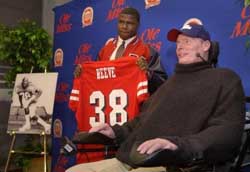
- March 22, 2002: At the University of Mississippi in Oxford, Christopher Reeve gave a half-time speech in a benefit event honoring Roy Lee "Chucky" Mullins, a University of Mississippi defensive back paralyzed in an Ole Miss' Homecoming game against Vanderbilt University in 1989 who eventually died from the injury. Reeve came to receive an $85,000 donation to the Christopher Reeve Paralysis Foundation from the University of Mississippi Sigma Nu Fraternity and pay tribute to Mullins. Reeve said of Mullins, "Sometimes it just takes one person to get a whole movement going." Reeve continued, "Apparently, Chucky was someone admired by his community. And it's a shame he was injured at a time when there was such little knowledge in the medical field about spinal cord injuries. We've come so far since then." Reeve added, "Your entire body is devastated. Pneumonia, collapsed lungs - they are common occurrences that have happened to me along the way, but (doctors) have always been able to save me. Chucky just wasn't as lucky." After Mullins's injury, Ole Miss' Sigma Nu chapter began a Charity Bowl football game, pitting its members against rival Sigma Chi. In 12 years, the game has raised more than $555,000 for spinal cord research. At a press conference in the Rebel Club at Vaught-Hemingway Stadium prior to the Charity Bowl, Reeve wore a navy blue Ole Miss cap when Kevin Thomas, the 2001 Chucky Mullins Courage Award winner, presented him with a replica of Mullins' jersey - a red number 38. Reeve was welcomed at the news conference by Governor Ronne Musgrove, Ole Miss Chancellor Robert Khayat, and Senator Trent Lott.
- March 24, 2002: In his second interview on the radio show On A Roll broadcasted live from Florida, and hosted by "the wheelchair dude with attitude" show founder Greg Smith, Christopher Reeve called in on Oscar night from his home in New York to promote new public service announcements put out by the National Organization on Disability (N.O.D.) and the U.S. Department of Labor. Reeve also talked about an upcoming center the U.S. government is opening on paralysis called National Health Promotion and Information Center for People With Paralysis that will be run by Reeve's foundation through a non-competitive cooperative agreement awarded to them. Reeve also expressed his outrage about the Kodak Theatre not building in wheelchair accessible seats and also talked about an upcoming movie project. About the N.O.D. celebrity spots Reeve said, "You know, it's just really brave of them to come out and say ah 'Now look I'm I'm no good at something' ah because a lot of times ah these same sensitivities we sort of make a total seperation, you know, between ability and disability. But the fact is all of us, you know, no matter what condition we're in, all of us have things we can and can't do." About the upcoming paralysis center to open in early May, Reeve said, "This is a place that I wish had been around when I was injured, in 1995, because when you're injured...I mean, your whole world changes with what to do or where to go or or who to call ah you know for all the needs you're gonna have to have and ah now it's all under one roof, under this resource center that we were given money by the government to ah to run this resource center on everything about paralysis." About the Kodak Theatre controversy, the new home of the Academy Awards, or Oscars, Reeve said, "...But to have an Oscar ceremony is insulting that doesn't have accessibility is a total disgrace." Reeve candidly added, "Well, in a way ah you know it's it's it's actually better that it happened at the Oscars then in a resturant someplace because we'll get such attention... In a way, it's a bad thing, but a good thing at the same time." Reeve talked about a movie project he is going to direct: "Well, the next project I hope to do is a ah film on a true story about a young woman named Brooke Ellison about who was injured about eleven years old ah in 1990 and very high level of injury, spinal cord injury, but she went to school an um with with her mother accom-accompanying her and ah went all the way through Harvard and graduated summa cum laude with a degree in Neuroscience... It's just a story about ah somebody who refused to be pushed aside and ah so we worked on a script and ah right now it's in the budgeting process ah not quite sure when it will start." Reeve also talked about the criteria he uses in choosing projects, "We'll because everything is more difficult then it used to be ah it's hard to go on location. It's harder to travel, etc a little um but I'm really looking for stories ah about meaningful relationships; stories about ah you know people who make breakthroughs...so I wanna do stuff that is actually about something ah rather than just takin up space." At the end of the interview, Smith offered Reeve to come on his show regularly to reach out on the airwaves to the disability community. Reeve is supposed to make another appearance on On A Roll when the paralysis center opens.
- April 2, 2002: Milton Hershey School (MHS) and Harrisburg Area Community College (HACC) are launching an annual series of high profile, inspirational speakers, beginning with An Evening with Christopher Reeve, on Thursday, April 11, at 7:00pm in Founders Hall in Hershey, Pennsylvania. Reeve will talk about his experience, and how he continues his directing career while also advocating for effective treatment of spinal cord injury and diseases of the brain and central nervous system. In addition to the evening event, Reeve will spend time earlier in the day with students from the Milton Hershey School. Dr. Bill Larkin, MHS Director of Organizational Development said in the press release, "We're thrilled to host Reeve for our inaugural event...His example of overcoming difficulties is a shining one, and I'm sure our students, as well as the greater community, will find much meaning in his message."
- April 3, 2002: The Coalition for the Advancement of Medical Research (CAMR), Christopher Reeve's special interest group for lobbying for embryo research, today launched a national advertising campaign to support Somatic Cell Nuclear Transfer (SCNT), sometimes called "therapeutic cloning." Reeve as Chairman of the Christopher Reeve Paralysis Foundation and member of CAMR said, "We urge Senators not to deny hope to millions of people with life-threatening diseases, and to listen to those for whom SCNT could be a matter of life and death." Reeve added, "These ads explain that SCNT produces stem cells, not babies, using the patientÕs own DNA, not sperm." In the first phase of the campaign, during the Congressional recess, CAMR is buying radio and print ads in major cities in the home states of key Senators. CAMR plans to expand the reach of the ads, and include television ads before the Senate vote.
- April 3, 2002: In Raising The Bar: New Horizons In Disability Sports, a new book about the Paralymics just published by Umbrage Editions, Christopher Reeve wrote the Preface. According to the publisher's press release, the book is produced in collaboration with U.S. Paralympics and the International Paralympic Committee, is an intimate, visually rich, elegantly produced portrayal of the international community of disability sports: individuals with disabilities who compete in a wide panoply of events from fencing to boccie, shot put to downhill slalom, cycling to equestrian events, swimming and wheelchair tennis to sitting volleyball and sailing. The book features the words and images of star athletes like Shea Cowart and Marlon Shirley, the WorldÕs Fastest Amputees; Jean Driscoll, pioneer of wheelchair participation in the Boston Marathon; and Erik Weihenmayer, the first blind man to summit Mount Everest; an essay by writers and advocates Artemis Joukowsky and Larry Rothstein; and extensive resource lists. The book will also examine the new technological advances in adaptive technology that have catapulted competition into new dimensions.
- April 8, 2002: New Jersey Network announced in their press release that Christopher and Dana Reeve are to be awarded at the upcoming 9th annual NJN Gala event on June 6, 2002 at the East Brunswick Hilton that honors individuals and organizations that have demonstrated an outstanding commitment to young people, education and community building in New Jersey. The annual NJN Gala is the major fundraising event of the NJN Foundation, the nonprofit arm of the network that raises revenue through corporate, foundation and individual giving in support of the state's public broadcasting system.
- April 28, 2002: In his third interview on Greg Smith's radio show On A Roll, Christopher Reeve called in from his home in New York to promote the new National Health Promotion and Information Center for People With Paralysis, known as Christopher and Dana Reeve Paralysis Resource Center, and take calls from listeners for the hour. About how the center was established, Reeve said, "Well, we at first were involved in ah you know promoting um more research into ah you know cure. But while that's happening we ah we realized that not enough is being done ah for people just still on a day-to-day basis ah so fortunately, the Center for Disease Control in Atlanta ah they proposed this to us actually ah as a line item in their budget ah so we've been given federal money to do this ah so we're quite honored that they trusted us to ah answer the needs of people living with paralysis." During the interview, Reeve also blamed the American public for not embracing embryonic stem cell research when it debuted in 1998 by not allowing "full government support and funding" in time for him to meet his personal goal this year of standing to make a toast on his 50th birthday. Reeve said, "I don't think that people understand what cloning really is... Those cells can be used to ah create any tissue in the body without ah without being rejected and yet there's ah big confusion that that's destroying life... There's legislation in the Senate right now that's tryin to ban it all and ah we're working really hard to stop that." Reeve also transposed the results of a poll recently released on human cloning to favor his position. The actual poll Reeve referenced showed that across the political spectrum--both liberal and conservative Americans alike- solidly support a ban or moratorium on cloning for both reproduction and research purposes, but Reeve singled out only conservatives saying, "...Also you should know that ah the latest opinion poll is 68% of the American public ah supports therapeutic cloning and ah only 26% are against it ah and yet we've got a couple of a very conservative ah Republican senators tryin to hold the whole thing up." About the new center, Reeve also said, "The staff there will be making referrals to ah a variety of groups who are associated with us... So we're like a switchboard, like a rooting center." Smith also asked what he does for fun, Reeve said, "Well, I wanna make a lot of time for family. I've got three kids and ah they're different ages, so one's 22 and ah my daughter's 18 and my other son is nine so ah you know I wanna you know spend as much time as I can with them. And ah we also try to get out a lot you know and... we go to the city, we go to the theatre, we go out and see friends, we do stuff... and then I spend about four hours a day in physical therapy." Reeve added, "Four hours a day, yes--breathing, and ah on the bicycle, and every Friday I do aqua therapy, which is great." Reeve also heard eight callers on a variety of subjects, like: asking for his support for Virginia Assembly bill H.B. 1105, which he praised; the new paralysis center; how to get grants from his foundation; a fan; a request for him to publicize two federal ADA lawsuits filed by the caller against the North Carolina Democrat Party for holding conventions at a nonaccessible place, which Reeve declined; how to start a foundation; and a caller who asked Reeve to reconsider his position on embryonic stem cell research to which Reeve gave the caller this confusing answer, "Well I'll tell you what um considering that so you really don't need ah um you know that kind of research so much because scientists have found something better ah and that's um nuclear transplantation, in which you don't use a fertilized egg ah so you just take ah an egg and ah then you put the patient's DNA into it. And it's not the union of a male and female so it'll never be a life and they can still get ah stem cells out of that. That's what we're fighting for now." Reeve added, "Well just remember that that these ah they're only about five days old and ah they're unfertilized, they're not fertilized so they can't become a person...that's important to remember though." Smith concluded the interview asking Reeve what's coming up, Reeve said, "I have a book coming out ah this September and I've got ah my son graduating from college in May, ah a lot of travel, and a lot a lot of advocacy work to do and ah first of all the paralysis center opens."
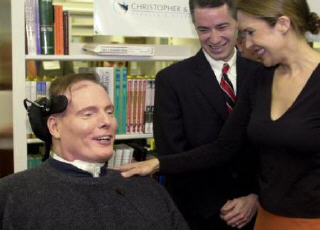
- May 3, 2002: In Short Hills, New Jersey, Christopher and Dana Reeve christened new The Christopher and Dana Reeve Paralysis Resource Center (PRC) that will provide information services to people nationwide who are newly paralyzed, have been living with paralysis, or are family members or caregivers. Reeve said, "One of the most disabling aspects of paralysis is the lack of resources and support necessary to get back into a world that has completely changed for the paralyzed individual -- both economically and socially." Reeve continues, "When somebody is first injured or as a disease progresses into paralysis, people don't know where to turn. Dana and I wanted a facility that could give support and information to people. With this new Center, we're off to an amazing start." Mrs. Reeve added, "Our mission is to promote the health and well-being of people living with paralysis and their families." Mrs. Reeve continued, "Our new facility, combined with our already established grants programs, will provide the most comprehensive help available. We're focused on helping people with mobility-related disabilities become more independent, more empowered, and better able to live the lives they choose." PRC was started by a grant from the Centers for Disease Control and Prevention. The Governor of New Jersey was also in attendance.
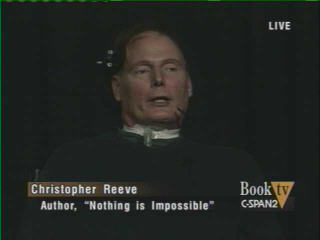
- May 4, 2002: New York City hosted BookExpo America, a book and author lunch forum, where Christopher Reeve discussed his upcoming second book Nothing Is Impossible which will be published by Random House in October 2002. Reeve gave the keynote speech at the luncheon and was among three authors there talking about their upcoming books. The other two authors attending were Pete Hamill for his new novel Forever and Roone Arledge for his memoir Roone. In addition, Barney Rosset was awarded the Curtis Benjamin Award for Creative Publishing. Patricia Schroeder presented the award. The BookExpo was broadcast live on C-SPAN 2. BookExpo America is the largest book trade show in North America. It is co-sponsored by the American Booksellers Association and the Association of American Publishers. It features more than 2000 exhibitors, as well as educational sessions, panel discussions, book signings, and meet-and-greet events.
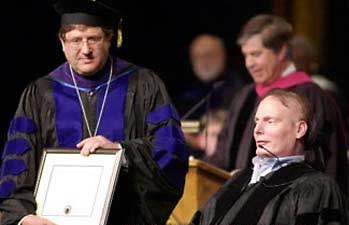
- May 5, 2002: At the New England Institute of Technology's 61st commencement, Christopher Reeve praised the graduates for taking up the technical curriculum in an effort to better their lives saying "I want to salute the courage of all of you" in his first commencement speech of the year. Reeve joked about his condition and said it was the graduates who deserved admiration for pursuing a degree in midlife or avoiding trouble on the streets. "I look out at this vast body of people, and I think, yes, yes, people doing the right things with their lives. That inspires me, too," he said to a crowd of 5,000 at the Rhode Island Convention Center. Reeve was awarded an honorary degree along with Frank J. Montanaro, president of the Rhode Island AFL-CIO. Guest speakers included U.S. Rep. James Langevin, who read a congratulatory letter from President Bush.
- May 8, 2002: According to a press release from Washington University School of Medicine in St. Louis, Missouri, Christopher Reeve will address students graduating during the School's Commencement Recognition Ceremony on Friday, May 10th.
- May 10, 2002: At Washington University School of Medicine in St. Louis, Missouri, Christopher Reeve addressed students graduating in the School's Commencement Recognition Ceremony in The Ferrara Theater at the America's Center in his second commencement speech of the year. In his address, Reeve went off on a tangent publicly indicating to the graduates he has a personal vendetta against Senator Sam Brownback (R-KS) centering around a strong bill Brownback introduced that would outlaw all human cloning. Reeve mentioned Brownback by name four times during his speech with one time even accusing Brownback's office of planting a rumor with the media that he died. Reeve said, "I'd just like you to know I'm alive...thank you very much. Thank you. What is kind of fascinating about the press is that they didn't take a name or phone number of whoever it was that planted this rumor. We can't figure out where it came from...unless it was Senator Brownback's office...but more about that later." Reeve spent much of his speech talking about his personal frustration with the debate on whether the United States should allow human cloning saying, "You know, it's just something that as a patient, you know I sit here, and I'm often very frustrated because politics gets in the way of advancing medical science in this country as quickly as it could go. I go, 'Why? Why? Why do we have to make research, science, medicine, the best care for patients, why do we have to make that political? Why do we have to base it on the bottom line for companies? Where is the idealism that should form medicine?'...I don't want to turn this into a political forum, but I do have to ask questions that are very troubling." Reeve's final thought for the graduates was to be daring because he sees all doctors as ethical and monitored: "And so my hope is that all of you, whatever your political persuasions are, whatever your religious persuasions are, whatever your own personal feelings are, again, that idealism that you have today about service, about what medicine means, about what you can do, please don't lose that. Please don't lose that in the middle of your path as you go on in life because we need pure medicine. We need the best medicine. We need ethical behavior, ethical conduct but doctors are ethical. Their conduct is monitored. I believe in doctors."
- May 13, 2002: World T.E.A.M (The Exceptional Athlete Matters) Sports today auctioned bicycles from some of the most notable names in sports, journalism, entertainment and public service, including a bike from Christopher Reeve, at their Sixth Annual Celebrity Bike Auction. Reeve attended the event along with Senators Charles Schumer (D-NY) and John Kerry (D-MA), music producer and rap artist Sean "P. Diddy" Combs, three-time Tour de France winner Greg LeMond, Firefighter's from Engine 33, Ladder 9 and record-setting swimmer and sports reporter Diana Nyad. Other celebrities and notables whose bicycles were auctioned included Robin Williams, Yoko Ono, Tom Brokaw, Paul Newman, Britney Spears, Paula Zahn, Cal Ripken, The Honorable Rudolph Giuliani, Evander Holyfield, David Halberstam, Nelly, Wynton Marsalis and Campbell Brown. The event was held at The Lighthouse at Chelsea Piers. Proceeds from the auction will benefit World T.E.A.M. Sports' Face of America 2002 bicycle ride -- a three-day, two-night, 270-mile journey from New York City to Washington, D.C. to honor the lives of those killed on September 11 and to inspire hope as the nation moves forward. World T.E.A.M. Sports Co-Chairs Jim Benson and Peter Kiernan, the organization's founder and founding director respectively, were honored for their vision and leadership of the organization. World T.E.A.M. Sports also honored the five firefighters from Engine 33, Ladder 9 who biked across the United States to thank the country on behalf of their fellow firefighters killed on September 11.
- May 20, 2002: In the latest newsletter (Number 4, Spring, 2002) that arrived from The Reeve-Irvine Research Center, there is an update on the experiments that Dr. Hans Keirstead is doing from a contract agreement with Geron Corp. of Menlo Park, with matching funds provided by Biostar, a University of California program designed to promote university-industry cooperation. According to Dr. Oswald Steward, Geron and Biostar provided sufficient funding to allow research on human ESCs (embryonic stem cells) to begin immediately, rather than being delayed until federal funding came online. Steward also wrote: "So the first challenge is to develop techniques for coaxing the stem cells to become neurons and glia. When they're growing as ESCs, the stem cells exist as small spherical clusters. By trying a variety of treatments with molecules that regulate early development (growth factors), Dr. Keirstead has been able to develop at least some preliminary techniques for turning ESCs into neurons, glia, or a mixture of the two (which is what exists in the brain and spinal cord). He is now carrying out critical experiments in which he is transplanting these 'differentiated' ESCs into the injured spinal cord of rats while treating the rats with the same types of immuno-suppressive drugs that are used in human heart, liver, or kidney transplant therapy. The results of these experiments won't be known for some time. We need to find out whether immunosuppression allows the ESCs to survive in rats, whether the ESCs integrate themselves into the neuronal circuits that are important for function, and whether these new circuits actually restore function. Initial results should be in by the end of this year."
- May 22, 2002: ABC television aired the special David Blaine's Vertigo at 10:00pmET live which Christopher Reeve appeared, during daylight hours, on a street in Bryant Park, New York talking about the magician following a clip of New Yorkers talking about Blaine doing his stunt. For this special, Blaine's third, he balances himself on a circular platform, 22 inches in diameter, atop a free-standing 100-foot pillar - without the benefit of any safety net or airbag - for 35 hours then exits by plunging from the summit of the tower to street level with only cardboard boxes to break his fall. Reeve was seen saying during the first half of the special: "Well, I wanted to come down to support my friend David. And what this is about is sheer endurance. It's about mental discipline, physical discipline, courage. This is not trickery. He is a magician, but he also is doing things that really inspire all of us to do more than we think we can do. What he is really doing is showing us mind over body. David is a extreme example of it, but we can all do that. We push ourselves safely much further then we think we can in life, will be a lot richer because of it." Earlier in the day, Reeve also attended a meeting with the New York Spinal Cord Injury Research Board that he has been a member of since 1999. The terms of all the members on the board last until December 31, 2002.
- May 23, 2002: It is announced through a press release that a new 16-part documentary series called Freedom: A History of US, that Christopher Reeve is the Creative Consultant on, will air on PBS nationally beginning on January 12, 2003 with Katie Couric hosting. "We have all been consumed by the events of September 11th and we've been asking ourselves how we can make the world a better place," said Reeve. "One way is to educate our families about what America stands for, about the value of freedom." Reeve and the producers have assembled a cast that includes: Julia Roberts, Robin Williams, Anthony Hopkins, Meryl Streep, Morgan Freeman, Angela Bassett, Reese Witherspoon, Sean Connery, Billy Crystal, and Kevin Kline. The documentary tells the poignant and finally triumphant story of the ever-widening circles of American freedom through unusual archival film, artwork and rare photographs, combined with vivid, first-person accounts read by many well-known actors. It is the story of that light of freedom seen through the eyes of patriots, pilgrims, and pioneers - and also slaves, women, immigrants, and laborers, who struggled for their share of the American dream. The President and Mrs. Bush will introduce the series on PBS. The series also includes insightful commentary by Columbia University professor Eric Foner, author of The Story of American Freedom. Funding for this documentary is provided by GE and the Revson Foundation. It is a production of Kunhardt Productions and Thirteen/WNET New York. The producers are Philip B. Kunhardt III, Nancy Steiner, Peter W. Kunhardt, and Philip B. Kunhardt, Jr. The senior producer of the series is Dyllan McGee. Executive producers are Peter Kunhardt and Sandra Sheppard.
- May 26, 2002: The Observer, a British newspaper, reported that Christopher Reeve will direct My Year Off, a film based on the story of a British writer whose life changed when he suffered a serious stroke at the age of 42. Reeve will tell the story of former publisher Robert McCrum, now the literary editor of The Observer. According to their article, McCrum's book, which focuses on the difficulty of adjusting to the slow pace of life for an invalid, has already been adapted for the screen. Kevin Bacon has been approached to play the lead role. The film version of McCrum's acclaimed book, My Year Off, is to be shot this year in the United States. It will examine the devastating effect that sudden severe disability has on a man at his peak. The Observer explains McCrum's story: "In 1995, the year of Reeve's accident, McCrum was the high-living editor-in-chief at the London publishing house Faber and Faber. A man who 'burned the candle at both ends', he had been married for two months to the American journalist Sarah Lyall. One summer evening he went out to dinner at The Ivy, before returning home early with a headache. In the morning he found he was unable to move his left side and was forced to spend a terrifying day alone at home, trying to reach the telephone so that he could answer the frequent phone calls from his wife, who was in San Francisco. Finally rescued by members of his family, McCrum was rushed to hospital where he learnt he had suffered a stroke. A year of rehabilitation followed and with it a complete change in his attitudes."
- May 30, 2002: Upcoming on Sunday, June 2nd on MSNBC is a premiere episode of National Geographic Explorer: Clone! that will include a strong plea from Christopher Reeve, who favors cloning. Also shown, a Sacramento woman, having failed all attempts at fertility, explains her determination to clone a child. The documentary special attempts to answer the questions 'Can scientists really clone human beings? Should they? Is the cloning of animals a boon to world food production or a threat to the environment?' while looking at this scientific discovery that is both promising and controversial. The documentary is not anticipated to cover this topic too objectively and is expected to be tilted in favor of cloning for medical purposes, as was a similar special in Australia. According to columnist Robert Novak, Reeve and Michael J. Fox are going against the tide of American public opinion on the issue of cloning. Novak reported a poll conducted by The Polling Company in his April 22nd column The People vs. Cloning: "The issue appeared comatose until April 10, when Bush, who has gradually returned to actively pursuing legislation not related to terrorism, presided over a White House ceremony promoting the anti-cloning bill. That triggered the poll, commissioned by the Stop Human Cloning organization and conducted April 13-15, asking for reaction to the president's statement of opposition to 'research cloning which involves the creation of cloned embryos for the purpose of destroying them to retrieve stem cells.' Behind the 63 percent approval of Bush's position is a potential reverse gender gap for Democrats, with 68 percent of women agreeing with the president compared with 53 percent of men. African Americans were especially strong against cloning (65 percent). A statement modeled after Daschle's position, to permit cloning for medical research, scored 26 percent agreement overall."
- June 2, 2002: In an article by The Associated Press, Christopher Reeve is quoted saying that he is against cloned embryos being implanted into human beings. "While the research in animal models shows that it may be possible to use cloning to generate tissues and eliminate tissue rejection, it's important for the American public to understand that the methods used in this animal experiment should not be pursued in humans," said Reeve. "Research involving the implantation of a human embryo into a woman, even to derive lifesaving cells, crosses a very important line and we need to pass legislation that would prohibit it." Reeve was commenting on a study published in the June issue of Nature Biotechnology. The cow researchers removed the nucleus from a cow egg and replaced it with a skin cell containing the full DNA set from another cow. They then implanted the cloned embryo into a surrogate cow and let the embryo grow for about six weeks before removing it. They removed embryonic heart, skeletal and kidney cells from the embryo, grew them further in the laboratory - creating mini kidneys - and implanted the cloned cells into the cow that donated the original DNA. All of the cells thrived, with some of the mini kidneys producing a urine-like liquid. Despite the results, the fact that an embryo was grown for six weeks in a surrogate concerned even some therapeutic cloning proponents, like Reeve. The authors of the paper said they too are opposed to recreating their cow experiment in humans.
- June 2, 2002: Radio City Music Hall in New York City was where The 2002 Tony Awards, hosted by Bernadette Peters and Gregory Hines, took place that included Christopher Reeve in attendance. Reeve was likely there to watch the Williamstown Theatre Festival in Massachusetts get honored with the 2002 Regional Theatre Tony Award. The Theatre is the first summer theatre ever to receive the award. Based on a recommendation by the American Theatre Critics Association, this award is given to a regional theatre company that has displayed a continuous level of artistic achievement contributing to the growth of theatre nationally. The Tony Awards are presented by the League of American Theatres and Producers and the American Theatre Wing.
- June 5, 2002: Australian Biotechnology News announces that Christopher Reeve will be one of the keynote speakers at a new conference on stem cells to be held in Melbourne in September.
- June 16, 2002: The ABC Sunday morning political talk show This Week with Sam Donaldson and Cokie Roberts aired a live interview Roberts did with Christopher Reeve on the subject of human cloning. Rutgers researcher Wise Young, who agrees with Reeve's position on embryonic stem cell research, said: "The segment began with Senator Landrieu from Louisiana saying that it was not possible to guarantee that doctors will not transplant cloned embryos into women if the cloned stem cell treatments turned out to be effective. Christopher had to start out against that background. He made the point that stem cell treatments would be beneficial for many conditions, that politics is slowing down the progress of stem cell research, and that cloned stem cells would allow the use of the cells without immunosuppression. Christopher also pointed out the contradictory position that Brownback took, that he did not protest against all the fertilized eggs that were being destroyed in fertility clinics but instead attacked the use of these eggs for therapies." When Roberts asked if Reeve was happy that no cloning ban was passed by the Senate, Reeve replied: "No! That's a terrible thing because the practice will go on unregulated; uncontrolled and also what will happen if no action is taken is that our best scientists will go overseas. We will once again lose our pre-eminence. And what I really fear is that what we fear today will become commonplace tomorrow. In other words, I want strict government oversight of theraputic cloning with funding by the NIH so it is controlled and regulated. "But once you get private companies doing it on their own its going to be chaos."
- June 20, 2002: Secrets of the Sequence, a weekly public television series hosted by Lucky Severson, will include Christopher Reeve in future episodes to debate research using human embryos. The series, which is tilted to favor medical research using human embryos, includes Reeve to justify that position and has the first episode with him airing the weekend of June 28th. Dr. Jerry Falwell also appears in the episodes to counter Reeve's position. The show is syndicated or appears on different public television stations in various cities at different times.
- June 23, 2002: In Cleveland, Ohio, MSNBC held Summit For A Cure hosted by anchor Brian Williams, a two-hour program broadcast live from the Cleveland Playhouse that headlined Christopher Reeve and actress Fran Drescher, along with medical experts. The medical panel included: Dr. Eric Topol, M.D., Department Chairman for Cardiovascular Medicine, Cleveland Clinic; Larry Norton, M.D., oncologist, Memorial Sloan Kettering; Huntington Willard, Director, Center for Human Genetics, University Hospitals of Cleveland; Dr. Ron Krall, M.D., Sr. Vice President, U.S. Drug Development, AstraZeneca; Dr. Eve Slater, M.D., Assistant Secretary for Health, Department of Health and Human Services; Glenn McGee, Ph.D., Bioethicist, University of Pennsylvania; Dr. Mehmet Oz, M.D., Heart Surgeon, Columbia-Presbyterian Medical Center. Williams also checked in on the progress of Dr. Toby Cosgrove conducting open heart surgery to correct a defect in the heart of math professor Jerry Gold. Cosgrove is the Department Chairman for Thoracic and Cardiovascular Surgery at the Cleveland Clinic. Reeve and Bay Buchanan debated in the second hour by satellite on whether using human embryonic stem cells found in embryos or fetuses after abortions are ethically and morally acceptable to use for research and treatments in the United States. Buchanan expressed uneasiness about using embryonic stem cells and said she would rather have scientists focus on the noncontroversial adult stem cells advancing taken from bone marrow. Reeve debated assuming "cloned human embryos will never ever become people" and that "the Petri dish is their final destination." The Summit concluded that as scientists learn more and more about the genetic defects that cause certain cancers, scientists can design molecules that target specific defects in the cells that go haywire and that cures may be the result of a happy confluence of the successful mapping of the genome and advancing technologies in drug research.
- June 26, 2002: An open letter from Christopher Reeve, to the Australia Parliament and Prime Minister John Howard, was delivered by Australian Perry Cross, who like Reeve is also a quadriplegic inspirational and motivational speaker. In the letter Reeve wrote: "...Australia's stem cell scientists are recognised around the globe. Your decision to support their research will ensure Australia continues to be a world leader in this exciting field. The benefits to the people of Australia, ensuring the earliest possible access to new therapies and treatments, are immense. For this reason I would say Australia is truly a lucky country. My circumstances unfortunately prevent a visit to Australia at this time. I do however look forward to the day when I might walk with my family along your beautiful pristine shores..." Howard also introduced legislation in Parliament and sent an Explanatory Memorandum from his office titled Research Involving Embryos and Prohibition of Human Cloning Bill 2002 to the House of Representatives as spreading opposition to the embryo provisions builds in Australian government ranks to allowing scientists to experiment with human embryos.
- July 1, 2002: Variety reports that ABC will air a series of three specials titled Christopher Reeve: I Will Walk Again that chronicle Reeve's recovery and are filmed by his son Matthew Exton Reeve. Matthew, a film student at Brown University, first pitched his father on the project, which intimately follows Reeve's daily life, to which Reeve agreed, and Matthew began scouting for outside support, finally partnering with U.K.-based producer TWI, the programming arm of Intl. Management Group. The footage includes the dramatic moment when Reeve is able to move his finger for the first time. The documentary will also chronicle Reeve as he testifies in support of stem cell research. Matthew Reeve, producer Stuart Watts and executive producer Alastair Waddington began the project 18 months ago. TWI approached ABC this spring about picking up the trio of programs. ABC will likely air the first special either around Reeve's September 25th birthday or during November sweeps. The two other installments will air sometime in the next two years as developments in Reeve's condition warrant.
- July 1, 2002: Rosie O'Donnell tells Mediaweek.com of Rosie Magazine's November 2001 edition, that had actress Drew Barrymore on the cover, which she wanted to lead with an interview she did with Christopher Reeve describing how he taught his son to ride a bicycle. The cover shot of Reeve "made my knees weak." O'Donnell is still waiting for her Reeve cover. But the editors "won't do it...they want me," she said, noting the package has been gathering dust for seven months. Though O'Donnell is a half-owner of Rosie, G+J's editors have final say over the magazine's contents.
- July 11, 2002: In a press release, the cable channel Discovery Health announced that it has a new primetime series, Medical Profile, premiering in September that reveals celebrities, including Christopher Reeve, in a different light through one-on-one interviews with those who have wrestled, or continue to wrestle, with health and medical conditions while living in the public eye. Medical Profile premieres on Monday, September 30 from 9-10pm ET and will air regularly on Mondays at 9 PM. Each one-hour episode will spotlight a different celebrity and his or her medical issue ranging from diabetes to depression to obesity. Through compelling, first-person accounts, the stars tell in their own words how they struggled and overcame, or learned to cope with, their private medical issues while maintaining their lives as public figures. Other celebrities to be featured in the series include: Carrie Fisher, Roseanne, Quincy Jones, and Sarah Ferguson. The series is produced for the Discovery Health Channel by KPI and Great North/Alliance Atlantis. Vincent Kralyevich and Kristy Sabat are executive producers for KPI TV. David Gullason and Maureen Palmer are producers for Great North/Alliance Atlantis. Executive producer for Discovery Health Channel is Claire Vande Polder. Bob Reid is executive in charge of production.
- July 13, 2002: Two U.S. magazines hit the newsstand with Christopher Reeve in them. In the August 2002 issue of Ladies' Home Journal, Reeve has a two-page printed oral essay with pictures, as told to Kathy Brewis, titled My Life Today that originally was printed in the U.K. newspaper The Sunday Times. People Weekly's July 22, 2002 issue, includes Reeve in the Insider column by Mark Dagostino on page 41 noting that Reeve and his wife Dana celebrated their 15th anniversary on June 30th, even though they've only been married for 10 years. Dagnostino wrote: "Turns out June 30th marks the day they met at the Williamstown Theatre Festival in 1987. 'For both of us, we really feel like our lives changed the day we met,' Dana tells me. The couple are looking forward to their next milestone. On Sept. 25 Reeve will celebrate his 50th birthday in New York City with a fundraiser for his Paralysis Foundation. On the guest list are a few older celebs who share his birthday-- a group which calls itself the 9-25 Club and includes Barbara Walter, Catherine Zeta-Jones and Michael Douglas."
- July 31, 2002: Creators Syndicate published a letter from Christopher Reeve in their advice column Annie's Mailbox by Kathy Mitchell & Marcy Sugar requesting, as Vice Chairman of the National Organization on Disability, readers donate their old cell phones. Reeve wrote, "...There are an estimated 55 million old cellular phones tucked away in drawers around the country. We are asking your readers to donate their old cell phones to Sprint Project Connect, recently launched through the help of campaign spokesperson and award-winning actress Marlee Matlin. Phones can be dropped off at any participating Sprint Store or Easter Seals location nationwide, or readers can see a list by accessing our Web site, www.nod.org. These phones will be recycled or resold, and a portion of the proceeds will benefit the National Organization on Disability and Easter Seals..." Also appearing in that day's column, besides Reeve's letter, was a female reader seeking advice about getting a tattoo against her family's wishes and another reader writing for advice about a friend committing adultry who uses her as cover to her husband against her will and approval.
- August 9, 2002: AARP, an organization formally known as American Association of Retired Persons, has Christopher Reeve in the September/October 2002 issue of both their My Generation and Modern Maturity magazines. In My Generation, Reeve is among a handful of celebrities pictured and quoted on the last page celebating their 50th birthday in the months of September or October. In Modern Maturity Reeve is interviewed by Claudia Dreifus in a three-page article on him that also had an excerpt from Reeve's upcoming book Nothing Is Impossible: Reflections on a New Life. When Dreifus asked Reeve if he was vain before his accident, Reeve said: "Not really. I was concerned about my health. I would have found it unacceptable to become obese, for instance." When asked if he was emotionally prepared before his accident to live as he is now, Reeve answered: "I don't think I was better equipped than any other individual. Most people can do extraordinary things. You read about a mother who lifts the front of a car to save her baby. And after 9/11, we saw how ordinary people--emergency workers, firefighters--did amazing things..." Reeve also said he believes in Holistic Therapy, the mind healing the body, like when he used it in 1997 to to heal his left ankle that was severely infected and about to be amputated. When asked where he finds the stamina to exercise everyday, Reeve said: "I actually think the discipline I learned in 28 years as an actor helped a lot...there's a scientific paper coming out this fall hopefully proving that the exercise I've been doing has kept me about of the hospital." When asked when the upside has been to his situation, Reeve answered: "Well, I wouldn't have had the appreciation of some of the more ordinary things in life. One of my favorite moments was an afternoon I spent with my youngest son Will. He was six and wanted to ride a bike without training wheels. The standard way for a parent to teach it is you put your hand behind the seat and run along until they get it. I talked him through it, in the driveway in front of the house--telling him how to push the pedal, urging him not to oversteer. It took out a half-hour, but he did it. When Dreifus asked Reeve if he ever dreams of himself in the wheelchair, Reeve answered: "No. Not ever. Everyday in this chair is a day I'd prefer to spend standing." Reeve also talked about dealing with insurance companies and controversial medical research he favors.
- August 12, 2002: In a statement Christopher Reeve released through the Christopher Reeve Paralysis Foundation, he praised the Bush Administration for implementing President Bush's guidelines for embryonic stem cell research from last year by "clearing away red tape, urging private owners to share access to existing stem cell lines, developing a stem cell registry, and streamlining the grant approval process at the National Institutes of Health" before claiming that the controversary surrounding the research is steering scientists away because not enough, for Reeve's preference, are applying to use the available stem cell lines and he also contradicted himself by impatiently criticizing that "the President should reevaluate his policy, untie the hands of scientists, and give them the full support of our government." Reeve's complete statement reads: "A year ago President Bush made a major policy decision which directly affected 100 million Americans facing presently incurable diseases and disabilities. He announced that federal funding would be allowed for research using embryonic stem cells, but he put limits on how that money could be applied. While the decision was widely endorsed at the time as a reasonable political compromise, a full year later it is still unclear to what extent it is helping the people who need cures and treatments most. In the past 12 months, some good stem cell research has been done and the proof of principle has been established. In addition, to its credit, the Administration has helped to implement the President's decision, clearing away red tape, urging private owners to share access to existing stem cell lines, developing a stem cell registry, and streamlining the grant approval process at the National Institutes of Health. However, I am concerned about the restrictions the President imposed on August 9, 2001. President Bush declared federal dollars could be used to study only excess embryonic stem cells that had been harvested from fertility clinics prior to that date. The government would not support research that involved the creation or destruction of additional embryos. Like many others, I doubted that there were enough stem cell lines currently in existence to allow scientists to make the kind of progress patients need. In 2001 the President said there were approximately 60 stem cell lines available. More than halfway through 2002 in fact only 17 lines are available for researchers, and it appears only 2 line owners are actually sharing these lines with research labs. Sadly, the political climate surrounding stem cell research has steered many scientists away from pursuing it and many companies away from investing in it. This will only further delay breakthroughs that may one day be compared to the development of penicillin, polio vaccines and flu shots. It would have been a tragedy if those breakthroughs had been delayed by political compromise. We must avoid making that tragic mistake now. On the anniversary of his decision, the President should reevaluate his policy, untie the hands of scientists, and give them the full support of our government as they pursue this critical research."
- August 19, 2002: Christopher Reeve: Courageous Steps, the first of three ABC television specials directed by Matthew Reeve and narrated by Christopher Reeve will premiere September 18th at 10:00-11:00pmET. The special features never-before-seen footage and unmatched access to Reeve and his family from May 27, 2001, the sixth anniversary of his accident, to the present by focusing on Reeve's personal life at home with his family, as they share in his rehabilitative and recreational activities, and offer a look at the medical aspects of his recovery, as he works with his doctors as well as Reeve schmoozing for political support for controversial research like embryonic stem cell research.
- September 1, 2002: To promote his second book Nothing Is Impossible: Reflections on a New Life, in bookstores September 17th, Christopher Reeve has a few familiar stops on his calendar. This includes a fourth live chat for America Online at 7:30pmET on September 19th; a new 20/20 interview with Barbara Walters to be aired Friday, September 20th; a new Larry King Live interview Monday, September 23rd; and Today on Tuesday, September 24th.
- September 10, 2002: A report by the Associated Press indicates that Christopher Reeve has regained some movement and sensation in his hands and feet, seven years after a horse-riding accident that left him paralyzed from the neck down. "To be able to feel the just lightest touch is really a gift," Reeve said. Chris can move the fingers on his left hand and the toes on both feet. He can feel a pin prick on most parts of his body and can tell the difference between hot and cold, and sharp and dull. Reeve documents his progress in an up-coming new book, "Nothing is Impossible: Reflections on a New Life," and in an ABC program airing September 18.
- September 14, 2002: The Toronto Star, a Canadian newspaper, published an interview with Christopher Reeve by Barabra Turnbull about his progress. Turnbull wrote about the regular activities Reeve does daily. About Reeve's exercise schedule, Turnbull reported that some days it is four or five hours long. "That is something that I work for, as overall preparation for whatever recovery comes in the future. That has always been my philosophy since I was first injured. I started exercising in rehab and never stopped." Turnbull detailed Reeve's regimen and appearance writing: "Mornings he either works out on an exercise bike or electrically stimulates his muscles. Every other day he does breathing exercises for an hour before dinner to strengthen his diaphragm. He does weight-bearing exercises on a tilt-table, which stands him up to his full 6-foot, 4-inch height, and he does water therapy once a week. He carefully watches his nutrition. In person Reeve looks robust and healthy, still handsome, despite a losing battle with alopecia, a condition he has had since a teenager that causes hair loss. It's claimed his eyebrows and much of the hair on his head, but it's hard to see past those steel blue eyes." About how Reeve's medical history since becoming a quadriplegic, Turnbull wrote: "During his first couple of years as a quadriplegic, Reeve battled a near-constant battery of complications that had him checking in and out of hospital: bouts of pneumonia, a collapsed lung, blood clots and urinary tract infections. He hasn't been hospitalized in 3 1/2 years now, which he credits to exercise." About privacy Turnbull wrote of the number of people Reeve employs to take care of him: "Reeve has 15 nurses who rotate 24 hours a day, seven days a week, and 10 to 12 aides who help with exercise in the mornings and evenings. There are two full-time workers in the basement office managing the business affairs and schedules of Reeve and his wife." Reeve said: "Since May 27, 1995, I haven't been alone anywhere." Reeve continued: "Before that time, I spent a lot of time alone and I really enjoyed it. That's been a tremendous sacrifice. Yet everybody who works here understands how to do the job: be around when necessary, but also give me space." Reeve also encouraged, "I believe when you're paralyzed for any reason, or if you have a serious disease, the most important thing to do is to live your life to the fullest - even if not for yourself, for the people around you." Reeve continued, "Most of us have families, children, who need us, people who don't want to see us just wallow in depression and hide away from the world." About turning 50 years old, Reeve said, "I think that if I was turning 50 and I was still on my feet, I might have found it really depressing." Reeve continues, "A lot of people I know hit 50 and think this is the beginning of old age. They project this downward spiral. But if you've been injured when you are younger than that, you've already been down to the bottom, so the number isn't that frightening."
- September 17, 2002: New York Daily News published an article by Donna Petrozzello, the day before the ABC documentary Christopher Reeve: Courageous Steps airs, interviewing Christopher Reeve about his progress. Reeve told Petrozzello: "It's opened the door to just about anything. We can throw out logic and just keep going." Reeve also raised the hopes of others like him saying, "The common wisdom has always been that with an injury as serious as mine, you could only expect recovery to happen up to six months or a year later, but I'm getting recovery about five years post-injury. If it happened to me, there's a chance it could happen to many others." Reeve's progress also includes reversing osteoporosis. About "walking" across the pool assisted Reeve said, "That was an incredible experience for me. The fact that I actually took steps forward, even though I needed a lot of assistance, reaffirmed my belief that I am going to walk again."
- September 17, 2002: The Guardian, a British newspaper, published an interview with Christopher Reeve by Oliver Burkeman where he raged about U.S. policy on the controversial embryonic stem cell research and the Catholic church. Reeve ranted assuming, "If we'd had full government support, full government funding for aggressive research using embryonic stem cells from the moment they were first isolated, at the University of Wisconsin in the winter of 1998 - I don't think it unreasonable to speculate that we might be in human trials by now." Reeve then went off on a long tangent when he raged to Burkeman about President Bush's embryonic stem cell decision last year and the role he thinks the Catholic church played in the decision, "We've had a severe violation of the separation of church and state in the handling of what to do about this emerging technology. Imagine if developing a polio vaccine had been a controversial issue," he says. "There are religious groups - the Jehovah's Witnesses, I believe - who think it's a sin to have a blood transfusion. What if the president for some reason decided to listen to them, instead of to the Catholics, which is the group he really listens to in making his decisions about embryonic stem cell research? Where would we be with blood transfusions?" Reeve continued sarcastically telling Burkeman, "Some religious and social conservatives say that that egg, by itself, is an individual. I find it hard to understand. If that egg is an individual, it means it has the same status as a living human being. When human beings die, the next of kin ordinarily have a funeral. So if you follow their logic, women should be having funerals for these so-called individuals that they lose every 30 days. I know it's a rather cynical way to look at it, however, it's very important to look logically at the problem, rather than emotionally." Burkeman wrote that Reeve too is emotional. Reeve said, "I do have an emotional response, sitting here, approaching my 50th birthday, to opponents who do not have a consistent moral point of view," Reeve continued: "I'm angry, and disappointed... I think we could have been much further along with scientific research than we actually are, and I think I would have been in quite a different situation than I am today." Burkeman also wrote that President Bush spoke in April clarifying his previously stated position on embryonic stem cell research and cloning in the East Room of the White House before The President's Council on Bioethics weighed in with their conclusions on the subject, Reeve said, "Who knows what might have been accomplished if there had been fair play politically?" Reeve admitted to Burkeman, "You know, the accident's power is diminishing. Do I wish it hadn't happened? Absolutely... but I find that it's best to think, well, what can I do today? Is there something I can accomplish, a phone call I can make, a letter I can write, a person I can talk to, that will move things forward? We have to learn to live a new life that would not have seemed possible. But that's not something you need to be Superman to accomplish."
- September 17, 2002: Scandal erupts the day before the documentary Christopher Reeve: Courageous Steps airs on ABC over Christopher Reeve's comments to the British newspaper The Guardian on the Catholic church relating to President Bush's decision on embryonic stem cell research last year. In response, Richard Doerflinger, deputy director of Pro-Life Activities for the U.S. Conference of Catholic Bishops, said: "Bush has placed no restrictions on stem-cell research but has limited funding. Mr. Reeve's Paralysis Foundation has millions of dollars to spend on research and is spending most of it on other avenues because they are more promising. His research has shown adult bone marrow stem cells can produce an ample supply of nerve cells for therapies." Catholic League president William Donohue also commented on Reeve's remarks: "It is nothing if not slanderous for Reeve to suggest that Catholics are the only ones left who respect the sanctity of human life. While it is true that the Catholic Church leads the way in this just cause, there are many Protestants, Jews and Muslims (as well as non-believers) who feel the same way. Human life does not begin at birth. It does not begin at 'quickening.' It does not begin at implantation. It begins at fertilization. This is not Catholic opinion. It is Biology 101. Ergo, stem cell research and cloning of all types are immoral. Moreover, the line between church and state is not crossed when a president comes down on the same side of an issue that a world religion does. Even to imply as much is invidious: the thrust of this remark is to abet an abridgment of Catholic free-speech rights. Reeve sounds more like 'Stupidman' than 'Superman' when he suggests there is some kind of cabal at work between President Bush and Catholics. The fact that President Bush opposes utilitarian ethics makes him an honorable man and has nothing to do with any alleged conspiracy. Reeve has every right to make his case in favor of embryonic stem cell research and therapeutic cloning, but he has no right to engage in Catholic baiting while doing so."
- September 18, 2002: In an article published in the New York Times titled Cash Diverted From Research on the Spine by the newspaper's anti-Pataki writer Richard Perez-Pena that cites and quotes Christopher Reeve, as a member of the New York Spinal Cord Injury Board, on the underfunding of the Spinal Cord Injury Trust Fund during the state's current budget shortage. Reeve said that when he learned that money had been siphoned out of the program, he contacted Governor Pataki and Dr. Antonia C. Novello, the state health commissioner. He said they both assured him that the program would be fully financed in the future but did not promise to replace the money that was taken out. "It does concern me," Reeve said of the slow pace of spending. "I believe that in New York State, the individual grant program is not as strong as it should be. It may be because there are not enough research scientists, as yet, who are working on spinal cord injuries." John Signor, a Pataki administration spokesman, said in an e-mail message that the governor intended to restore the money, though that is not a binding commitment and that New York "takes a back seat to no one in its support for outstanding spinal cord injury research." Signor also said in his e-mail message to Perez-Pena, "It has been the board's policy to fund only projects of the highest merit, even if that did not result in spending $8.5 million every year," the annual allocation provided in the law. Signor added that the state would invest $15 million over the next five years to create a center for spinal cord injury research and treatment, at an existing hospital.
- September 18, 2002: A statement from Christopher Reeve was released through Witeck-Combs Communications regarding his remarks to The Guardian: "My remarks about President Bush consulting with Catholics before issuing his decision concerning embryonic stem cell research on August 9, 2001 were not intended to disparage the Catholic Church or Catholics in any way. Freedom of religion is a basic principle of our society. I would never criticize anyone for being a practicing Catholic, nor would I tolerate criticism against me for being a practicing Unitarian. However, I do believe in the separation of church and state. Our government should not be influenced by any religion when matters of public policy are being debated. Because the Catholic position was given so much publicity at the time, I singled them out for criticism. It was absolutely inappropriate for me to do so. I wish to apologize not only to the Catholic Church but also to the faithful of any religion who may have been offended." William Donohue, President of The Catholic League followed up with his statement: "It was commendable of Christopher Reeve to extend an apology to Catholics for his unfortunate remarks. It would be remiss of me not to mention, however, my disappointment with that section of Reeve's apology which speaks to his continued support for the principle of separation of church and state. This was wholly unnecessary-only ignorant Americans would disagree. What is troubling here is the implication: it suggests that it is improper for religious men and women to try to affect public policy. But religious apartheid is always objectionable, even when dressed in constitutional cloth. This caveat notwithstanding, Reeve's apology strikes us as sincere and therefore brings closure to the issue."
- September 19, 2002: In this fourth live chat with America Online, Christopher Reeve talked about the documentary that aired yesterday, his second book Nothing Is Impossible: Reflections on a New Life, his progress, research, and wealthly patients, like himself, who can afford to have the staff and resources necessary to make the kind of progress that he is making to which Reeve answered: "Beside my desire to improve my overall health and gain some recovery, my main desire is to prove that exercise and physical therapy can cause recovery and better health for others. It is my hope that insurance companies will understand that they will profit from providing patients the kind of staff and therapy that I had. At the very least, a person with my level of injuries will not spend so much time in the hospital. This will save the insurance companies money. Persons with lower-level injuries will recover the ability to walk and no longer need insurance. This has already been proven in a number of facilities that train paraplegics how to walk by using a treadmill. The most important point is that we can have a win/win situation where insurance companies will save money and patients will improve and recover."

- September 19, 2002: In Washington, D.C. Christopher Reeve, as Vice Chairman of the National Organization on Disability, presented Ecuadorian President Gustavo Noboa, on behalf of his country, with the sixth annual Franklin Delano Roosevelt International Disability Award at an 11:00amET ceremony in Conference Room Four of the United Nations Building. At the ceremony Reeve told Noboa while presenting the award, "This is a time of great hope and promise for the hundreds of millions of people with disabilities worldwide." Reeve continued, "When governments make it a priority to ensure equal opportunities for their citizens with disabilities, they maximize people's potential. People with disabilities want to make the most of their abilities, and this year's FDR Award winner, Ecuador, is to be commended for its dedication to making it possible for them to do so." Reeve said he was "in awe" of Ecuador's accomplishments and wished the cash prize could have been larger. "I wish it could be 50 times that amount or more because you deserve it," he said. "But I hope that you understand this token is in recognition of how grateful we are that even in the most difficult situation the world has ever faced -- and we are now facing global crises of proportions that we could scarcely have imagined 15 years ago -- that you are still working so hard to improve our minority, the members of the disability community in your society." Reeve then called on members of the United Nations to adopt a U.N. convention on the rights of the disabled. "One of the main purposes of the United Nations is to bring the world together, and the Convention on the Rights of People with Disabilities would do so much to make sure that that 10 percent of the world population that is so much in need is included in society, as it should be, so I hope that convention will be adopted." Reeve's comments earned applause from the audience of international diplomats who gave him a standing ovation. Reeve was joined by Madame Louise FrŽchette, Deputy Secretary-General of the U.N.; Anna Eleanor Roosevelt, the granddaughter of former U.S. President Franklin Roosevelt; Kenneth Behring, Founder, Wheelchair Foundation; Ambassador William vanden Heuvel, Co-Chair of the Franklin and Eleanor Roosevelt Institute; and Alan A. Reich, Chairman, World Committee on Disability. The Franklin and Eleanor Roosevelt Institute and the World Committee on Disability honored Ecuador for its progress on disability issues. The country has placed equal opportunities for people with disabilities at the forefront of its national agenda for decades, beginning with the establishment of the National Council on Professional Rehabilitation in 1973. According to a press release from National Organization on Disabliity, the Constitution of Ecuador was revised in 1994 to include guarantees of access for people with disabilities to healthcare, education, training and work. A press release from World Committee on Disabilty says that the Award includes a bust of FDR, and $50,000 for an outstanding disability program in Ecuador. In addition, Behring is donating 1,000 wheelchairs to people with mobility impairments in Ecuador. Past recipients of the Award are the Republic of Korea, Canada, Ireland, Hungary and Thailand.
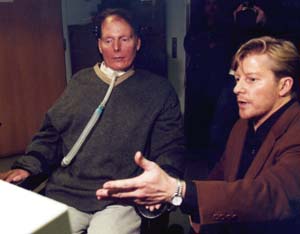
- September 20, 2002: A study published in the September 2002 issue of the medical magazine Journal of Neurosurgery: Spine titled Late recovery following spinal cord injury chronicles Christopher Reeve's medical history as well as his exercise regime and the amazing results from it. The study, written by Reeve's doctors: John W. McDonald, M.D., Ph.D., Daniel Becker, M.D., Cristina L. Sadowsky, M.D., John A. Jane, M.D., Ph.D., F.R.C.S.(C)., Thomas E. Conturo, Ph.D. and Linda M. Schultz, Ph.D endorses more serious research in the area of regeneration, rather than embryonic stem cells, and "does not address the basis for the patient's recovery, mechanisms of regeneration, or whether regeneration accompanied functional recovery because such associations cannot emerge from studies in living humans. It does demonstrate, however, that substantially delayed recovery is possible. Therefore, further investigations into the role of neural activity in regeneration and functional recovery appear warranted, both in the laboratory and in clinical trials. Predictably, the most rapid progress will occur through basic science, which can tightly control variables and assess indices of regeneration; however, we hope the work described here will spark additional clinical investigations into the effects of long-term rehabilitative and medical interventions for individuals with SCI and other disorders involving immobility. Such interventions might enable individuals with spinal cord disabilities to achieve physical and functional benefits that previously were not thought possible. Because extensive patterned neural activity appears important for recovery, we suspect that patterned activities will show much promise." The doctors viewed the "most dramatic demonstration of reversing 'learned non-use' has come from the results of training people with SCI. Two forms of adaptations occur after injury that may contribute to improved locomotor function: development of spastic muscle tone and activation of spinal locomotor centers induced by treadmill training. Groups have shown that a distal disconnected region of the spinal cord is capable of "learning" and that early gait training might promote improved gait, endurance, and energy consumption, enhanced ground speed walking, and, in a minority of individuals with incomplete SCI, improved overground walking. The major benefits of gait training are reserved for those with incomplete injuries, particularly ASIA Grades C and D. Therefore, motor training appears to have effects that exceed those produced by exercise or FES alone. The FES bicycle system described here may provide a unique balance to gait training in that it may prove to provide benefits in the more severely affected individuals with SCI. Thus, a growing body of work supports the activity-based recovery hypothesis and the lack of alternative treatments accelerates the need to test promising new approaches." The doctors summarized that "the individual described in this paper has experienced substantial recovery of function and his condition is now classified as ASIA Grade C, two ASIA grades better than ASIA Grade A. Associated physical benefits include reduced spasticity and increased bone density and muscle mass. Although we cannot conclude that the activity-based recovery program produced the functional benefits, we believe it was responsible for the physical benefits. As this outcome was seen in a worst-case scenario, the program might provide even more dramatic benefits for individuals who are less severely injured (ASIA Grades B-C)."
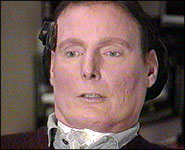
- September 20, 2002: In another interview with Barbara Walters for 20/20, Christopher Reeve talked about a two-year try-out period, after he became paralyzed, on deciding whether he would be able to live as a quadriplegic or opt out and die. Reeve also talked to Walters about his progress, lobbying for research, and his and Dana's love life. About the two-year try-out commitment that Dana used to coax him to live where at the end of two years, if he still wanted to die she would try to help him find a way. "She used 'the oldest salesman's trick in the book,'" Reeve said. "Try this for two years, if you don't like it, you can send it back." Reeve added, "It involved being willing to go through a lot of suffering... many, many trips to the hospital and near-death experience. ...It was years before I was even stable." About religion Reeve said that he had spent a good part of his life before the accident searching for some kind of spirituality, and says he finally feels that he knows what it is: a quote from former U.S. President Abraham Lincoln that he keeps on a wall in his office. Reeve said, "Lincoln said, 'When I do good, I feel good. When I do bad, I feel bad.' And that's my religion." In the interview, taped before the controversy surrounding his comments on the Catholic church and President Bush's embryonic stem cell research decision that Reeve since issued a written apology for this week, Reeve said, "I think President Bush made a political decision that was influenced by social and religious conservatives. Well, there are 61 million Catholic voters in this country. That's a strong voter base. I feel that no religion should have a seat at the table in this discussion." About their love life, Dana said that she expects Reeve to be an attentive husband, a good father, and to do as much as he can. She also said, "We're as physical with each other as we can be and we're as close as we can be."
- September 22, 2002: In Sacramento, California, the same day the Academy of Television Arts & Sciences held the 54th Annual Primetime Emmy Awards, Christopher Reeve was present at a morning bill signing that embattled California Governor Gray Davis held for S.B. 253 on controversial embryonic stem cell research, a bill that overreaches federal guidelines set last year by President Bush. Reeve said, "The political debate has had a chilling effect on our scientists. It is painful to contemplate what advances could have been made." The California bill declares that the policy of the state shall be that research involving the derivation and use of human embryonic stem cells, human embryonic germ cells, and human adult stem cells from any source, including somatic cell nuclear transplantation, shall be permitted, as specified; require a health care provider delivering fertility treatment to provide his or her patient with specified information; authorize a donation of a human embryo pursuant to specific requirements and would prohibit the purchase or sale of embryonic or cadaveric fetal tissue for research purposes. Also attending the bill signing was movie producer and director Jerry Zucker. President Bush's reaction to this bill becoming law was conveyed through White House spokesman Ari Fleisher aboard Air Force One, "The president has always said states have authority within their states." Fleisher later added, "The president thinks that all policies - state or federal - need to promote a culture that respects life and, in that, he does differ from what California and the governor there have done." This is the second bill that passed in California in recent years that Reeve directly backed. The first was A.B. 750 Roman Reed Spinal Cord Injury Research Act of 1999 which established the Spinal Cord Injury Research Fund.
- September 23, 2002: While promoting Nothing Is Impossible: Reflections on a New Life, Christopher and Dana Reeve appeared on Larry King Live for most of the hour. The couple candidly talked about the unusual progress Reeve has made in recent years, the television documentary made by Matthew Reeve, a bill introduced in the U.S. Congress in his honor, a bill in California, religion, acting, as well as taking eight calls. On his progress, Reeve said: "But the main message, Larry, is it's really not just for me...I'm privileged. I have a staff. I have the equipment. But the one thing that I really hope comes out of this is that there's a paradigm shift in the way we look at what insurance should be doing to give people equipment so that they can accomplish the same thing that I have been able to accomplish. And that's really, really key. Otherwise it's just one individual." When King pressed further about his exercise routine being exclusively for wealthy patients, Reeve said: "Frankly, everything that I can do can be done by a family at home. Well, even if you have a pool in your house, you could do the aqua therapy. But riding on a bike and using electrical stimulation of the muscles, the breathing off the hose, you can do that with your own family. And also you can do it at rehab centers as an outpatient. The main thing that will make a difference is that insurance companies need to pick up this therapy and pay for it, because they will profit off of it. People like me will stay out of the hospital and people with lower level injuries will get up and get out of their chairs." About a bill about to be introduced in the U.S. Congress, Dana Reeve said: "Yes, and one of the things it will establish, a center of excellence in all 50 states. So if you can't afford or if insurance is still a snafu for your family, you can go somewhere where it has the exact same equipment that Chris has been using..." When King asked if his progress lessens the need for the alternative embryonic stem cell research, Reeve said: "No, not at all. As a matter of fact, there's been a really wonderful development in California just the other day. The state legislature has authorized a bill that would allow the state government to fund research on stem cells derived from any source. And that's a tremendous breakthrough. And I hope that it creates a grassroots movement across the country." About whether the documentary Christopher Reeve: Courageous Steps was his idea or his son's, Reeve said: "No, no. It was actually Matthew's idea. He's an art and art history and art theory student at Brown. And once the finger moved in September of 2000, and Dr. John McDonald at Washington University wanted to do a study, Matthew came to me and said, can I do a documentary? And I thought, yes, this is a way to help him start with the career he's interested in. Also, I wouldn't want a stranger following me around. That was really important." About religion, Reeve said: "Well, believe it or not, in my book, 'Nothing is Impossible,' I have divided it into two chapters: the search for spirituality, one chapter is on faith. The other chapter is on religion. In a way they're kind of different for me. Because as a kid, religion seemed to be a bit scary, that somebody sort of -- you were kind of guilty while going into church. And it sort of sometimes made you feel bad. But over time, you know, I have actually become a Unitarian. And we embrace that because it's all inclusive and it's about the goodness in people. That God, you know, loves us and that he assumes that we are good. And also it just assumes that we have a moral compass inside us. And we kind of know what's right..." On acting again, Reeve said: "I'll be directing. Hopefully in the spring. And -- but no plans for -- sorry. No plans for acting right now, but directing coming up." Reeve added: "Well, what's amazing is that I acted for 35 years and never won an award. And then I did a movie, Rear Window, after I was injured, and I got the Screen Actors Guild award for best actor. Go figure. Who knows?" Reeve also made an unqualified prediction about embryonic stem cell research saying: "Well, stem cells are the research with embryonic stem cells and stem cells derived from nucleus transplantation. It's still in its infancy because of political controversy in the federal government, which now fortunately has been broken through and adopted by California. But I think they're going to be able to start getting this into humans within the next three years or so." Reeve also gave advice to equestrians saying: "OK. Wear a helmet. Don't exceed your abilities. But as a parent, don't make your child afraid. Because if she does it with fear then she might be injured. But my daughter Alexandra, who I taught to ride, she gave it up for a while. And I said, no, continue, you love it. And now she's playing polo for Yale. So you have got to let people go ahead and do their thing and do it safely."
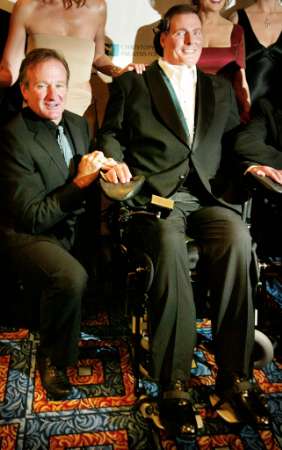
- September 25, 2002: The 2002 Reeve-Irvine Research Medal, along with its $50,000 cash prize donated by Joan Irvine Smith & Athalie R. Foundation, was awarded to Sten Grillner, Ph.D. who is Professor of Physiology at the Karolinska Institutet in Stockholm, Sweden at Magical Birthday Bash held at the Marriott Marquis in New York City for Christopher Reeve who celebrated his 50th birthday. Russ Penniman, Vice President of the Joan Irvine Smith and Athalie R. Clarke Foundation and Dr. Oswald Steward, Director of the Reeve-Irvine Research Center and Chair of the Scientific Advisory Committee of the Christopher Reeve Paralysis Foundation, presented Grillner the award. Grillner was awarded in recognition for his finding that the spinal cord can operate autonomously to control motor function that has led to the development of novel treatments for patients with spinal cord injury and may have contributed to the recent recovery Reeve has recently experienced. Grillner's work defines the basic organization of spinal circuitry that underlie rhythmic activities setting the stage for essentially all the activity dependent therapies being done by scientists today. This year's 13th annual Magical Evening was hosted by actress Kim Cattrel, who appeared with Reeve in Above Suspicion. Celebrities attending included Michael Douglas with his wife Catherine Zeta-Jones, Barbara Walters, and Ron Meyer who also celebrated their birthdays. Robin Williams was the event's special guest. Also attending was U.S. Department of Health and Human Services Secretary Tommy Thompson, from the Bush Administration, who traded compliments with Reeve. Reeve said Thompson "believes in the value of medical research and believes that politics and medicine must be separate." The event raised $2 million for the Christopher Reeve Paralysis Foundation.
- September 25, 2002: In this week's edition of UK Now magazine is an exclusive interview with Christopher Reeve titled, "One Small Step For Christopher." The interview reveals Reeve's remarkable recovery since the injury that left him paralysed. This includes the ability to wiggle his toes on both feet, move the fingers of his left hand, raise his right hand, and distinguish between hot and cold, and sharp and dull sensations over his body. In July 2001 Reeve added weekly aquatherapy to his exercise regime. Consequently Reeve has found the ability with the help of aides to kick his legs forward and make his way across the pool, "People were cheering," Reeve said, "I've been an actor since I was a kid and this was definetly show time." Reeve also revealed that he still believes in the possibility of walking again and that, "Even if your body doesn't work the way it used to, the heart, mind and spirit are not diminished, it's as simple as that." Back issue can be ordered via the Now magazine website.
- September 25, 2002: Access Hollywood aired an interview Christopher Reeve did with Billy Bush, a relative of President Bush, from his home in New York. Reeve talked about how he first thought his finger moving was a fluke: "Well, I just thought that it was such a fluke that it didn't make sense, because fine motor control like the finger is very sophisticated for the brain considering the injury, and it's way below the level of my injury, so there's no reason I should move. I was excited but I didn't want to get too excited because I thought it might be a fluke, but then I thought if that finger can move anything is possible." When Bush asked about rehab for his heart and mind, Reeve said: "Well, the thing is that what you're left with is heart and mind. That you never lose unless you give up. And giving up is unacceptable to me. But what you really want is control, even though you need so many people to do things, you still want control over what you do and then when you could loose your mind and work out your body with exercise and good care and then you start to begin to control the body as well. That's very cool." When asked what he will say during his toast during the party for his 50th birthday, Reeve said: "Thank you all for being here and for everything you've done to help the cause, and for any of you wondering why I'm not standing, first of all it was really like a motivator, to give researchers a kick and say 'go.' Let's have an end goal here, 'I'm 42, let's see by 50 how far we can go.' So I did it without knowing a lot about the science and I enjoyed my ignorance because I didn't have to know limitations imposed on me by the facts. But, clearly as in the case of my physical recovery five years later, facts could be disproved all the time and wisdom has to be revised frequently. But I will say that had there been full-fledged government support for embryonic stem cell research, when those cells were first isolated in 1998, I think it's fair to say that we'd be much further along than we are now and it's possible that I might have made it. But I don't want to dwell on that too much and I want to go forward." When asked what is the biggest laugh he's had in seven years, Reeve said: "Oh boy, we laugh on a daily basis. You saw the documentary and you see how often we laugh in the documentary. Early on I developed and appreciated a sort of sick humor. But I think perhaps the first joke I was able to laugh at just because it was so tasteless was the joke: 'What's the difference between Christopher Reeve and O.J. Simpson? O.J. walks.'"
- September 25-26, 2002: The Early Show aired a two-part interview Christopher Reeve did with Jon Frankel from his house in Bedford, New York. During the interview, Reeve talked about his life before and after the accident that paralyzed him; his activism on behalf of spinal cord injured people; and the personal progress he has made through physical exercise. Reeve told Frankel why turning 50-years-old this year doesn't depress him, "I'm so - surrounded every day by so much love, so much support - you know, people who challenge me and want the best for me." Reeve continued, "I hit rock bottom at age 42, I mean, I - nearly - nearly killed myself, you know, I was a hangman's factor. Then, I survived that, and I'm surviving this now, and going on." On his progress, Reeve told Frankel, "I started experimenting and tried everything. Tried different things, in a pool, on land, in bed, in the chair. You name it. I would just say, 'Let's do this.' And I remember one day telling the staff that 'Okay, today we're gonna go in the gym and I want you to put the chair next to a table. And get me out of it. Put me on the side of the table and I'm gonna try to sit up.' You know, sit up all by myself. And I was able to do it." Reeve added, "It's mind-over-body. It's repetition, it's discipline, it's also predicated on the whole assumption that the body wants to heal. The body wants to be whole." On what gives him a good moment, Reeve mentioned the Yankees as well as how he enjoyed personally talking to elected politicians, who do not represent him, on human cloning in efforts to supercede the constituents the politican actually represents by attempts to sway them through unqualified explanations. Reeve told Frankel, "I live in the moment. And if I'm focused on the Yankees, and they come from behind and pull it out in the bottom of the ninth, that's a good moment. And if I have a 30 minute conversation with a senator and - to explain therapeutic cloning to him and convince him to support it, that's another happy moment."
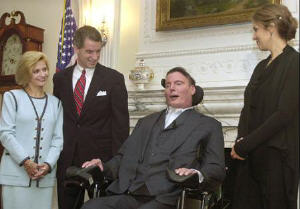
- September 27, 2002: At Drumthwacket, the New Jersey's governor's mansion in Princeton Township, Christopher and Dana Reeve attended a reception for the Christopher Reeve Paralysis Foundation to raise money for spinal cord injury research. During a press conference with the Governor to announce that the state is also considering legislation similar to a bill passed in California on embryonic stem cell research this week, Reeve said: "To hear the governor will already support the legislation is how we are going to get the job done." Reeve moved to Princeton Township at the age of three and moved out of New Jersey after graduating from Princeton Day School in 1970. During Reeve's 15 years as a resident of the state, he grew up on Campbelton Road and began his acting career as a stage hand at McCarter Theatre. At the press conference, Reeve also recalled his acting days with the PJ&B Players, named after the shuttle train from Princeton to the Princeton Junction train station.
- September 29, 2002: In England, BBC aired an interview Christopher Reeve did with David Frost on his show Breakfast with Frost where Reeve talked about his progress as well as giving President Bush a message. About doing more during aqua therapy Reeve said: "Yes well swimming is a euphemism really, I've done my exercising in the swimming pool, I, I do everything from sitting on a ledge and kicking my feet up and down with ankle weights on. I push off from the wall like someone doing the back stroke. I open my arms and close them sort of like doing a snow angel, sort of like a, you know like a flying motion and I'm also able to stand and take steps in the pool as long as I have enough people to hold up my upper body." Reeve told Frost his message to President Bush is: "My message to the President would be to, to rethink his position in light of the fact that there's overwhelming popular support in this country for proper stem cell research. You know when you have opinion polls of about at least 70 per cent of the American public are supporting this research I think he really needs to look again at his position and to re-evaluate it." About having the daily shock of waking up a quadriplegic lessening Reeve said, "Absolutely less and less and it's very interesting, when I'm asleep, you know when I'm dreaming I've never been disabled...In seven years I've always been out sailing and riding, skiing, doing things that are very active in my dreams and it turns out that just dreaming about those active things actually activates the motor-neurones in the brain so that part of my recovery may be due to the fact that I'm activating motor-neurones even while I sleep."
- September 30, 2002: To promote Nothing Is Impossible: Reflections on a New Life Christopher and Dana Reeve appeared on Donahue from their home in New York in an interview expectedly skewed to favor their position on the controversial embryonic stem cell research and cloning. During the interview, Phil Donahue twice mentioned to Reeve a fabricated New York Times story about former U.S. First Lady, Nancy Reagan, who in 2001 wrote to President Bush about the research, allegedly secretly trying to ease up the president's guidelines on the research. Reeve predicted that this research will be promoted at the state level saying repeatedly throughout the interview, "And my hope is that while the federal government is stalled on this issue, and they're paranoid about therapeutic cloning, as though it's some kind of dangerous slippery slope that we're going to go down. But we made that same mistake with test tube babies. So that was done in England and now it's common practice over here. So you talk about fear factor. Fear factor is usually language. But therapeutic cloning uses an unfertilized egg. And anyway, what I hope will happen is now a grassroots movement. California started it. New Jersey is going to pick it up. ItÕs going to go across the country." When Donahue asked Reeve is he is tired of being called inspirational, he said: "No...we are not larger than life. We really aren't, and that what we've done, yes, it takes perseverance, dedication, love. It's hard work. But we've seen-you know, 9/11 is a perfect example. There are examples every day of people dealing with much harder situations. So I just really would like us not to be elevated too high." Dana Reeve added: "But the difference is, is that because of ChrisÕ celebrity, people turn the camera in our direction. And what we have always done from the beginning is try to take that celebrity and turn it around to make something good come out of something that is difficult...for other people because it can be very tough going, and it is tough going for most people, for everyone who's in this situation, and for us, especially early on. But we have the support of the world, and we can also be the voice of all these silent partners, these caregivers who have no voice because they're spending so much time caring for loved ones, of people with disabilities who have also very little voice, in terms of policy change. And so that's our job." About raising his kids, Reeve said: "The assumption that most parents make is that we've got to be doing things together, got to do stuff with the kids, got to show them how to do things. You know what kids really want? They want you to be there for them. That's the most important thing. So it really doesn't make that much difference whether or not you can use your body. If your heart, your mind, your soul are with them, they know it, they receive it, and they grow."
- October 3, 2002: Congressman Mike Bilirakis (R-FL), Chairman of the Health Subcommittee of the House Energy and Commerce Committee, announced that several of his colleagues joined him last week in introducing the Christopher Reeve Paralysis Act of 2002 (H.R. 5458). According to Bilirakis' press release, the bill gives the National Institutes of Health explicit authority to award grants to further cross-cutting research on the causes of paralysis, with a particular focus on spinal cord injury, traumatic brain injury, and stroke. Recipients of these grants will be designated Christopher Reeve Paralysis Research Consortia, and will be encouraged to collaborate and communicate as much as possible. In addition, H.R. 5458, provides NIH with the authority to establish a multiple center clinical trials network, which will help design rehabilitation interventions for people with paralysis brought about by central nervous trauma and stroke. Finally, Bilirakis' bill gives the Centers for Disease Control and Prevention the authority to study the unique health challenges associated with paralysis and other physical disabilities and to fund projects to improve the quality of life and long-term health status of persons with paralysis and other physical disabilities. Reeve said: "I am extremely grateful that Congressman Michael Bilirakis has agreed to introduce the Christopher Reeve Paralysis Act of 2002. The bill is designed to enhance and further research into paralysis, and to improve rehabilitation and the quality of life for persons living with paralysis and other physical disabilities. Thanks to compassionate leaders such as Congressman Bilirakis, people across the country who are currently suffering from all forms of paralysis will be able to access better care and therapy, while cutting edge research is advanced under the guidance of the federal government."
- October 9, 2002: American Morning with Paula Zahn aired an interview Christopher Reeve did with Paula Zahn from his house in Bedford, New York. Reeve talked to Zahn about his progress, his activism, and able-bodied people who do not agree with his opinion on embryonic stem cell research through both typical as well as cloned or manufactured human embryos. On his progress, Reeve told Zahn, "Well, actually, it's all been kept a secret, because it started in November of 2000. And all the way until May of 2002, I was involved in intense exercise. And when I was first injured, I could only move my shoulders a little bit. And now, I can straighten out my legs, I can move my feet, I can open up my arms, I can move individual fingers. But I think in order to do what I've done, you need a lot of help. You need equipment, you need people to put you on the equipment." On walking again someday, Reeve said, "Oh, sure. Actually, I'm not even thinking; I'm planning. You know, and basically, I started exercising to maintain my health, but also to be ready for a cure if and when it comes. But I think that science and exercise can meet halfway. And certainly, the next thing we need to do is, particularly in this country, is to get politics out of the equation." To those able-bodied people who disagree with his views on research, Reeve told Zahn, "Oh, to just please keep an open mind to what I'm talking about, particularly if you're a hard-core opponent. You know, as I've said, you know, in any opponent, you know, just please spend one hour in a wheelchair like this, and not even able to scratch your nose or shift your weight. And then, let's resume the conversation after that. You know, you can't legislate compassion, but that's what's needed most. And what politicians have to do is just imagine what it's like to be somebody else. If we all did that, man, we could change the world."
- October 19, 2002: At Iowa State University's Stephens Auditorium, Christopher Reeve attended a private fundraiser and public lecture in the first of a two campaign stops he made in Iowa for Senator Tom Harkin, a 62-year-old two-term Iowa Democrat up for reelection. Harkin introduced Reeve as "a great American, a great friend of yours and mine" to which Reeve grinned. Reeve said, "I am here as a friend and supporter of Senator Harkin." After Harkin read several passages from Reeve's new book, Reeve told the audience, "I promise you that I did not prearrange for him to plug my book, but I'd recommend Amazon.com," he joked before criticizing the Bush Administration for limiting federal funding for embryonic stem cell research and opposing all forms of cloning. While speaking to a crowd of more than 200, Reeve accused the federal government of opposing biomedical research that would be "saving life from the garbage." Reeve spoke about the research saying Harkin among the leaders in Congress who are urging President Bush to rethink his position. About cloning, Reeve said he supports Harkin's legislation allowing the cloning of cells for medical research while outlawing human reproductive cloning. He argued in support of the allowance and regulation of cloning for medical research and the prohibition of cloning humans: "Many feel this is a slippery slope, and that this research could not be regulated," Reeve said. "There is a tremendous difference between reproductive cloning and therapeutic cloning." He also told the crowd there's a misconception and a campaign of misinformation surrounding stem-cell research: "Cloning sounds terrifying. It sounds like your worst episode of The Twilight Zone." Reeve stressed the benefits of stem-cell research, a possibility he said Harkin and several other politicians have already grasped. Reeve said political leaders must establish strict penalties for individuals or corporations who attempt human cloning. "The government must step in now," he said. "Otherwise, somebody is going to try to [clone humans]. That would be very bad for the country." After Harkin and Reeve arrived on stage, the audience viewed a video endorsement for Harkin from actor Michael J. Fox.
- October 20, 2002: At the Main Lounge of the University of Iowa's Memorial Union in Iowa City, Christopher Reeve spoke at the second of two events he attended this weekend stumping on behalf of Senator Tom Harkin (D-IO). Harkin introduced Reeve saying, "I need you to help get me back in the Senate, and that's why I asked Christopher Reeve to come out today...I want to continue the ever-evolving work I began with the Americans with Disabilities Act. There are a lot more people with disabilities working and a lot more people just going out and enjoying themselves...I want to continue my work of expanding the frontiers of medical research and medical knowledge...What we're talking about is some of the most progressive research. Christopher Reeve is living proof that nothing is impossible." Reeve spoke at length about supporting embryonic stem cell research as well as talking up Harkin's support of the Americans With Disabilities act which he co-wrote with former Senator and 1996 presidential candidate Bob Dole (R-KS), and the effect it has on his life. The crowd of about 300 people greeted Reeve with a standing ovation. It was his first time in Iowa, and while he only arrived Saturday, he said the state's beauty was stunning. "It's been a privilege to get to know about the rest of the country," he said. "Living with a disability is not an easy thing, but it's put me in touch with people I would not have met before and I have grown to really care about." Reeve's first encounter with Harkin was after one of his many speeches where he talked about the importance of finding a cure for illnesses and serious medical conditions. Afterward, Harkin approached Reeve and said he agreed with his speech, but was also concerned about providing immediate care. "That is what Harkin is all about," Reeve said. "Harkin is someone with desires and goals, but he never for a minute forgets about today and what can be done today." Reeve also talked about the need for further medical research and funds, by using his unusual progress as the example. "They said I would never retain any movement below my shoulders, that was the absolute I started with," he said. "But I'm a difficult person to get a long with, because I don't accept any absolutes. Reeve added, "But my improvement means nothing if it doesn't extend to people like me. That's why I am grateful for people like Harkin who help raise millions of dollars to help people with serious medical conditions." Reeve added, "One of the most important things that those suffering from these medical conditions can have is hope. I thought hope would be the product of money and science," he said, adding that Harkin has helped to provide funds, while facilities such as University Hospitals have provided progressive technology. Reeve also spent time giving unqualified explanations about the science of stem-cell research. He admitted that many are afraid of the term "human cloning," which he said can only hold researchers back from making a major discovery. "Fear is holding us back, and it's frustrating to be a patient," he said. Reeve spoke for nearly an hour at this event. Mayrose Wegmann of the University Democrats sponsored the event. Harkin's campaign hit a snag in September when Brain Conley, a former member of his staff, released the transcript of a closed-door meeting for his challenger Representative Greg Ganske.
- October 27, 2002: UK newspaper The Sunday Express published an interview with Christopher Reeve in 'S' Magazine. Reeve describes his fitness routine and the reaction of neuroscientist John Mc.Donald to his regained movement in his fingers, "I showed the doctor my finger movement, and from his reaction you'd have thought I'd just walked on water!" Asked to explain this recovery Reeve said, "The physical exercise may be stimulating nerve pathways that remained intact after my injury, but went to sleep through disuse. The other possibility is that the spinal chord - if driven by exercise - can regenerate to some extent. That's the only possible explanation, because there's been no medical intervention" Reeve adds that, "The only difference between me and other people is that I I've had the equipment to do these exercises. I've been able to afford things that should be availible to everyone, and should be paid for by insurance. I hope my progress will change the way insurance companies work." Of his role as an activist, and a continuing supporter of stem cell research and other medical issues surrounding the potential cure for paralysis Reeve say, "When I go, I want to be able to say that I tried to do something useful." Of his ability to carry on after previous setbacks in his condition after his injury he thanks his wife and family, "I owe her [Dana Reeve] everything. Dana and all my kids - Matthew 22, Alexandra 18, and Will 10 - made it clear from the start that they wanted me around. That made all the difference."
- October 31, 2002: At a press conference held in New York's Rainbow Room, Christopher Reeve talked about being the creative consultant for the upcoming 16-part PBS miniseries Freedom: A History of US. Reeve explained that he wanted to participate because his half brother, a teacher in rural Vermont, had trouble getting his students interested in history: "The kids don't want to read, they don't want to write and sometimes, the kids, and their parents, get so upset because they have too much homework." Reeve wanted well-known actors to provide voices for characters from American history, but he knew if he went through managers, publicists or agents he would get some brush-offs. So he wrote to the celebrities themselves. Susan Sarandon, one of the actor voices he assembled, surprised Reeve at the press conference with a $100,000 check made out to the Christopher Reeve Paralysis Foundation totaled from the actors donating their $1,000 fees, along with matches by corporate sponsors to make up the balance of the check.
- November 25, 2002: In Trenton, New Jersey, two New York lobbyists including Christopher Reeve, testified before the New Jersey Senate Health, Human Services and Senior Citizens Committee about S.1909, a bill that permits human stem cell research in the state. In Reeve's testimony he slammed the federal government's policy on stem cell research saying: "The federal policy on embryonic stem cell research is misguided and inadequate." Reeve also cited a report released by the National Academy of Sciences titled Stem Cells and the Future of Regenerative Medicine that, according to adjunct scholar Steven Milloy, was written by a panel made up of known proponents of stem cell study with vested financial and/or professional interest in the continued funding of that research. Reeve also went into detail about the technical procedure of cloning to stop the committee from removing it. Reeve said: "Nuclear transplantation unfortunately is still a mystery to many elected officials and the public at large. Scientists isolate an unfertilized human egg when it contains only approximately 100 cells. Then they remove the nucleus and replace it with the patient's DNA. Shortly afterwards, before the resultant pre-embryo develops any human characteristics, stem cells are derived that are not likely to be rejected by the patient's immune system. Clearly the issue of nuclear transplantation presents a great challenge to the Committee as well as the entire Senate. However, I urge you not to remove it from S.1909. Without it the bill will not fulfill the potential of life saving research and the State of New Jersey will miss the opportunity to lead the nation in an area where the federal government has failed us." Former New York City police detective Stephen McDonald, who was paralyzed in 1986 as a result of being shot in the line of duty, also testified at the hearing opposing the bill. McDonald said that even though he might benefit from such research, "I cannot walk away from the responsibility to protect a human life." The New Jersey Catholic Conference submitted a position paper saying that human life must be protected "from the moment of conception" and that "government must not treat any living human being as research material." It added that promising research using stem cells donated by adults raises no ethical objections. Ira Black, chairman of neuroscience and cell biology at Robert Wood Johnson Medical School also testified. The Senate committee narrowly got the bill out of the committee by the slimest of margins, a 4-0-2 vote with Senator Diane Allen (R-Burlington), and Senator John Matheussen (R-Gloucester) abstaining. Three abstentions were needed to keep the bill in committee. This year legislation in Iowa and Michigan passed banning all human cloning with Indiana, Louisiana, and Missouri to follow. The only state to allow all research on human embryos is California with similar legislation pending in Ohio, Virginia, Wisconsin and Massachusetts. The New Jersey bill, which now heads to the full Senate for consideration, would need Assembly approval before heading to the desk of the Governor.
- December 1, 2002: In Australia, New South Wales Premier Bob Carr announced that Christopher Reeve, in person, will be the keynote speaker at the Premier's Forum on Spinal Cord Injury and Conditions, a two-day conference hosted by the New South Wales Government held at the Convention Centre, Darling Harbour over the Australia Day weekend on January 27 and 28, 2003. Special arrangements, with Qantas paying for the jumbo's refit, for Reeve's trip include: flying to Sydney on a specially modified ordinary Qantas jet for the long-haul flight from the US, his first-class cabin being stripped of its normally plush seating and sealed off to form a makeshift medical ward for the star and his team of doctors. Carr said in a press release, "For the past three months, we have worked with Prince of Wales Medical Research Institute and Qantas who have extensive experience in carrying passengers with special medical needs, to make this trip a reality...But none of this could occur without the strength and the will of this outstanding man." About Reeve, Carr said, "Christopher Reeve's experience, bravery and passion are a symbol of hope for all people with paralysis...He is on a mission to bring about change not just for himself but for all people with spinal cord injuries and other central nervous system disorders...Christopher Reeve will join with some of the most highly regarded researchers, clinicians and practitioners working to improve the quality of life for people suffering paralysis, their families and carers." Up to 800 people will attend the forum to share experiences and learn about the latest research and therapies. Reeve's visit will cost New South Wales (NSW) taxpayers $134,300, or $US75,000.
- December 2, 2002: Outrage erupts in Australia over Christopher Reeve's upcoming trip. People with Disabilities, NSW's leading disability rights organization called on NSW Premier Carr to invest wisely in support services for people with severe spinal cord injury in the wake of his announcement that NSW is to pay for Christopher Reeve to fly to Sydney to participate in a conference on spinal cord injury next month. The complete statement reads: "We applaud the Premier's personal interest in issues affecting people with spinal cord injury. We also acknowledge with appreciation Mr Reeve's advocacy for improved treatment and support services for people with spinal cord injury. However, when it comes to the commitment of public funds, there are higher priorities than funding Mr Reeve to travel to Australia to address the conference in person. Our community's investment in high-tech medical responses to spinal cord injury must also be matched with the development of those support services required by people with spinal cord injury once they leave hospital. There are critical levels of unmet need for basic support services for people with spinal cord injury in NSW. There are currently around 300 people with disability on the waiting list for high-need personal care services that will allow them to live in the community with dignity and independence. There are also around 1500 young people with disability living in aged care facilities because they are unable to obtain the support services they need to live in the community. A significant proportion of these groups are people with spinal cord injury. The cost of Mr Reeve's participation in the conference - estimated by some media sources to be around $250,000.00 after taking into account travel, speakers fee, and personal care assistance - would be sufficient to support 5 people with severe spinal cord injury to live in the community for a year. In a climate of budget pressure and critical unmet need for support services, funds must be used wisely. Funding Mr Reeve to address to conference in person is not the best use of these funds. In this age of technology, Mr Reeve could very effectively address the conference by video link, freeing up a quarter of a million dollars for people who urgently need disability support services. In the lead up to the State election in 2003 we call on the Government and the Opposition to make a genuine policy and funding commitment that will allow all those people awaiting personal care services, or living in aged care facilities, to live a decent life in the community." Shadow Minister for Disability Services Brad Hazzard also said: "Premier Carr's record on delivering services to people with disabilities is abysmal. Now leading into the 2003 Election Bob Carr has found $140,000 to pay a fee to Christopher Reeve to visit Australia. Finding $140 000 now simply serves to highlight that for too long the Premier has ignored his specific responsibilities to provide people with disabilities in NSW with basic services. People with disabilities are asking - why $140,000 of taxpayers money can be found to bring out Mr Reeve, while Mr Carr for almost a decade, hasn't had enough money to: get 300 people with high needs out of hospital and into independent living (acute care); provide 100 people access to specialised care services they need (attendant care); get 400 young people with disabilities out of aged care nursing homes; provide respite for hundreds of carers across the State; ensure group homes have properly trained and adequate staff; reduce avoidable deaths for people with disabilities (see Mannix Report 2002) No one would dispute that Mr Reeve is a very good campaigner and spokesman for people with spinal injuries. Hopefully his presence will encourage Mr Carr to take seriously the problems of people with disabilities in NSW. Since Mr Carr literally ran away from people with disabilities during the last Election campaign, he has done very little to address their issues. It's all very well to be supporting fundraising to support stem cell research, but just once, it would be gratefully received by people with disabilities if Bob Carr could show that he was prepared to leap tall buildings to really deliver improved services for them." Physical Disability Council of NSW calls on Carr to show as much commitment to today's needs of people with spinal cord injury as he does to the "promise of science" and the contestable "hope about embryonic stem cell research." David Brice, President of the Physical Disability Council of NSW, said: "We are not opposed to medical research and we welcome any overseas visitor with disability to NSW. But none of us can escape the realities of how life is today for many people with disability in the towns and cities of NSW. We live in a sometimes hostile environment. Hundreds of people wait on Government lists for services at home top help them in and out of bed, domestic assistance, intimate personal care. People seeking equipment such as hoists and wheelchairs can wait over a year for them to be provided. Often they have to go cap in hand to charities for assistance. Transport, buildings, sports, recreation, leisure and cultural facilities and services can be like an assault course for many people with disability. For us, it is not what the Premier said on Saturday that is important . it is what he didn't say .. about help at home, inaccessible transport and services and the rest . that's what's important to us. We believe the Government must show itself wholly committed to addressing these priorities. The day after the Premier's forum is over, people with disability in NSW will face exactly the same set of problems as they do today unless the Premier acts now to commit his Government to systemic change for an inclusive future fall all."
- December 2, 2002: The Sydney Morning Herald put up responses to their topic Do you support the NSW government's decision to finance Christopher Reeve's trip?. Among the responses, Peter Boskov, a fan of Christopher Reeve passionately wrote: "im a huge fan and he is a brave man,but $134,000 of tax payers money for him to come out,no way you've got to be joking,the government cries poor all the time,raising taxes,cutting schools,health care,police, etc and they want to spend our hard earnt money for what?yes for what?havent we got enough problems in our own backyard where that kind of money could make a difference to some unfortunant 'australians',who the hell do these people think they are to even think of ripping off their own country this way,the people that want mr reeves here should pay out of their own pockets and not take advantage of all working australians,its funny we vote people in to do the right thing by the australian public then these idiots think they have the power to do anything they like,they forget who voted them in and thats a sad thing." Francis Cochrane wrote: "We all admire Christopher Reeve. His determination and courage are good examples for all. However, we can use the money better for our farmers and fire fighters who battle just as hard and in some case even harder.Keep my tax dollar with our Australian heros." Sylvie Hutchinson, in contrast, wrote: "As I'm sure he would find it physically more comfortable to remain in his own home, embarking on such an exhausting complicated voyage seems to me best proof of his own commitment and conviction to not only increase public awareness of such disabilities but also the will and hope to find a cure for them. I wish him a warm welcome and contribute with my taxes gladly."
- December 2, 2002: More statements were released about Christopher Reeve and family's upcoming trip to Australia. ParaQuad: Paraplegic and Quadriplegic Association of NSW released this statement in support of Reeve's trip. The complete statement reads: "The Paraplegic and Quadriplegic Association of New South Wales (ParaQuad) commends the Carr government for its initiative in bringing Christopher Reeve to New South Wales in January. ParaQuad recently held its inaugural Independence Day gala, at which a video made by Christopher Reeve for the event was screened. This was a tremendous contribution to the event by the Hollywood star. ParaQuad is an Association representing some 7000 members, many of whom have a spinal injury or related disability, supporting members to live independent lifestyles. Christopher Reeve's support for ParaQuad's event indicates the close relationship that Christopher Reeve already has with New South Wales. Further, the fact that the Gala dinner was raising funds for the accommodation of younger people with spinal injuries demonstrates that Christopher Reeve has an interest not only in spinal research but also in the quality of the lives of people with spinal injuries following an accident. With an investment by government, people with a spinal injury and related disabilities can lead fullfilling lives making significant contributions to their communities. ParaQuad views the visit by Christopher Reeve as an opportunity to create interest in both spinal research and in the needs of people living with a spinal injury." Australian Democrat Dr. Arthur Chesterfield-Evans released this statement condemning Reeve's trip for a State Government forum to be an expensive media stunt, a transparent ruse to deflect the Carr Government's record on the disabled. The complete statement reads: "Certainly Christopher Reeve is a strong advocate for people with disabilities, but the $134,000 that Bob Carr is spending to fly him from the United States is a waste of taxpayers' money, better spent on providing real services for people with disabilites. Bob Carr is using this forum to spin a message that he's committed to the disabled. He'll get on the news and spin, spin, spin like a spider. He's managing the media image, but not the State. I issue a challenge to Bob Carr and Christopher Reeve-take a train to the forum. Then you'll see the Government's level of commitment to the disabled and the elderly. According to his own figures, only 59 of Sydney's 306 railway stations are suitable for the disabled. Town Hall station, the busiest railway station in the whole of Australia, is not accessible to people in wheelchairs except if they go through the Queen Victoria centre-which is closed after shopping hours. St James station and Martin Place can be reached only from a long flight of stairs. Bob Carr should get out of his office in Macquarie Towers, and watch mothers with prams, elderly men and women, and people with walking sticks or walking frames as they struggle up two flights of steps at Sydney's metropolitan stations. Government neglect and penny-pinching on disabled issues is a complete disgrace. I'll take Bob Carr on a wheelchair tour of the railway or public transport system if he likes. We can even invite Christopher Reeve."
- December 6, 2002: The Age, an Australia newspaper, had an interview Christopher Reeve did with Caroline Overington by phone from his home in New York he talked about a bill the Australian Senate struggled to decide on passing that would allow research on some of the 70,000 "excess" embryos that are stored in IVF laboratories around Australia, the controversy surrounding his upcoming visit, and about being used by scientists in the debate over the use of human embryonic stem cells. On the bill that passed yesterday, Reeve was pleased and admitted that he closely watched the debate. Reeve said, "I was watching your debate closely, because in my opinion, it is important that the legislation is passed, because in Australia, like in most countries, one-third of all fertilised embryos that are created for IVF, are discarded when they are no longer needed." Reeve agreed to do the interview because he is aware of the debate surrounding his visit next month saying that he agreed to come to Australia because he wants to do in Sydney what he has already done in the US - confront the dogma that says injuries like his are permanent. Reeve thinks that if just one research scientist in Australia hears him speak and gets the shot of adrenalin he or she needs to find a cure...then the money will look like small change. The lives of thousands of people would be transformed. About being used as a political pawn by scientists who want to work in an exciting field to get access to research dollars that might otherwise go elsewhere, Reeve said: "But I am a healthy sceptic. No scientist can just sway me with words, with false promises. If they tell me something, I need a good deal of proof to be convinced. I am fortunate that I have access to some of the best scientists and researchers in the world, so I follow up and I do the research and I ask questions."
- December 10, 2002: In advance of Christopher Reeve's trip to Australia, The Australian published the article A wrong not even Superman can right by Angela Shanahan that offers Reeve harsh yet constructive criticism regarding his personal agenda of cure over care. Shanahan also talks about the politics surrounding Carr bringing him to Australia. Shanahan writes: "Christopher Reeve, once the image of the man who could bend steel with his bare hands, is now in life the most prominent symbol of what many regard as the living death of quadriplegia...In a world nervous of disability, the devastating nature of his injuries has given him a moral authority not granted to the able-bodied. But not everyone is as impressed by the direction in which Reeve's enthusiasm has taken him as they are by his obvious determination to find a cure for his injuries. In the world of disability there is muttering about his high-profile status...resentment and ambivalence about Reeve among disabled Australians have varied origins...In private, many disability activists are scathingly critical of Reeve's impending visit and Carr's agenda. Christopher Newell, a Tasmanian ethicist who has crossed swords with Reeve over his advocacy of cloning and embryonic stem cell research, says that Reeve represents a certain palatable image of disability that goes beyond his smiling, still handsome face and his articulate actor's presence. He is a celebrity quadriplegic who is able to focus the charitable impulses of patrons who can afford $275 a ticket for a dinner, and Carr's trump card in an ongoing campaign for research involving human embryos in which the Premier has invoked real people, including children...But most disabled people bear no resemblance to Reeve's sanitised and palatable image; he is rich, while most Australians with such severe disabilities are living below the poverty line...There is no doubt that Carr is using Reeve as a drawcard for his own attempts to set up biotechnology-based industry in NSW. He has been able to whip up public enthusiasm with the theoretical possibilities of using embryonic stem cells for spinal injury sufferers, although there is no proof that this future technology will have any practical application. Reeve is an ardent advocate of using cloning in conjunction with embryonic stem cell technology to engineer a tailor-made cure. But there is growing concern that the agenda he is championing is unrealistic. After all, foreign embryonic stem cells are incompatible and form tumours. And even if stem cell treatment were combined with cloning, it would be unaffordable - and, being tailor-made for the individual, would only be a rich man's medicine... the established fear among people with disabilities of the embryo selection techniques used by the in-vitro fertilisation industry, which they see as eugenics...But the truth is that the realistic prospect of a cure is extremely remote. And despite the Hollywoodist never-say-die mentality of Reeve, the main game for disabled people is how to exist on a day-to-day basis."
- December 14, 2002: The Daily Telegraph, in Australia, reports in their story Measuring up for Superman that Christopher Reeve's logistics manager Diana De Rosa is combing Sydney with a tape measure recording the dimensions of rooms, tables, stages, ramps and doors to send back to the US in preparation for his upcoming trip next month. De Rosa said, "There are issues with stages [in the Darling Harbour Convention Centre], table heights and entrances - even electrical currents which are different in Australia and the US. But my biggest concern is knowing where the hospitals are." Reeve's tall frame and larger than normal wheelchair require access issues to be brought up for his traveling. "It makes it a little harder, he needs more room when turning corners," De Rosa said. "We will use a van, hired locally, for his transport in Sydney." An organiser said Reeve's schedule was "hectic". "He will be in and out of hotels and venues - including the Premier's building [Governor Macquarie Tower] for a press conference."
- December 17, 2002: Times Square Business Improvement District and Countdown Entertainment announce in their press release that Christopher and Dana Reeve will join Mayor Michael Bloomberg to lead the final sixty-second countdown to the New Year and signal the lowering of the New Year's Eve Ball at the 99th New Year's celebration in Times Square. The Reeves have been selected by the organizers of the event "for their extraordinary courage, determination, and strength of spirit that inspires all of us as we begin the New Year." In a joint statement, Christopher and Dana Reeve said: "We are honored and humbled to be recognized as this year's Special Guests, in a city famed for its courage and perseverance. This has been a landmark year for our family and we could not imagine a more perfect way to end 2002. We are thrilled to be chosen to ring in 2003 -- a new year that promises progress in research and a better quality of life for those living with disability." The selection of the Reeves continues the tradition established by the Times Square BID and Countdown Entertainment of honoring outstanding individuals whose spirit and courage are an inspiration to others. The tradition was launched on New Year's Eve 1996/97 when 88-year-old Oseola McCarty -- a laundress who donated her life savings of $150,000 to the University of Southern Mississippi -- was invited to participate in the Times Square festivities. Since then, international hero Muhammad Ali, Nobel Peace Prize winners Doctors Without Borders, and former New York City Mayor Rudolph Giuliani in recognition of his leadership after September 11th have also served as Special Guests. The organizers also announced that at 10:40p.m.ET, Discover Card will host the world's largest synchronized bell ringing to usher in the New Year. New York's own Riverside Ringers bell choir and 70's disco diva Anita Ward will lead the bell ringing celebration.
- December 24, 2002: In the latest newsletter (Number 5, Winter, 2002) that arrived from The Reeve-Irvine Research Center, there is an update on the experiments that Dr. Hans Keirstead is doing on human embryonic stem cells. The newsletter says that, in September, Geron Corporation and University of California BioSTAR Projects renewed a matching grant to fund Keirstead's stem cell work. According to the newsletter: "The work has focused on creating central nervous system (CNS) myelin-makers, oligodendrocytes, to provide the insulation necessary for nerve cells to talk to each other. Dr. Keirstead has shown that after SCI there are often spared nerve fibers that are missing myelin, eliminating their ability to communicate with the rest of the CNS. Oligodendrocyte progenitors (which are very young cells) are also chemical factories - able to produce dozens of substances that may promote regeneration and healing. This means that in addition to remyelinating naked axons, they may also support axon regrowth via nerve growth factors or other beneficial molecules." The newsletter added: "Continuing research will explore whether putting stem cells that are pushed to become oligodendrocyte progenitors into the injured spinal cord can restore locomotor and bladder function." These results were presented at the Society for Neuroscience meeting in Orlando, Florida in November.
- December 31, 2002: A press conference on the sixth floor of Hudson Ballroom at 1568 Broadway was held just hours before the Times Square ball drop for Christopher and Dana Reeve to speak to the media for the first time about their selection to serve as the inspirational Special Guests who symbolically signal the lowering of the New Year's Eve Ball in Times Square and offer their messages of hope and courage for the New Year. Also appearing at the press conference were New York City Mayor Mike Bloomberg and President of Countdown Entertainment Jeffrey Straus. USA Today published an article titled New Year's Eve with Reeve where Ann Oldenburg interviewed Reeve about the nights events. Reeve told Oldenburg his biggest worry is breathing cold air because it's difficult for his pulmonary system, but, he says, he and Dana will have to be outdoors for only about a half-hour and there will be space heaters nearby. Reeve says a "chain link" will signal the start of the countdown. He'll hold his wife's hand; then his wife and the mayor will touch a mini version of the 6-foot Waterford crystal New Year's Eve ball on the podium. Then the lowering will begin, counting down the clock to new year. Reeve says he doesn't live in fear and has to be hopeful making this New Year's Eve the same as any other with only the celebration being different. Reeve explains: "Since the injury, what we've done is declared New Year's at 10 p.m. We toast in the new year generally up at our country place in Massachusetts, and we're in bed by 11 p.m. Usually on New Year's Day, all the kids want to be out the door, heading for the ski slopes or sledding on the hill in our backyard. This will be the first time since the injury that I'm staying up like a grown-up. We'll see the ball drop and party afterward as well, the whole nine yards." Reeve will also toast the new year: "What's New Year's Eve without a toast of champagne?"
- December 31, 2002: Prior to the the Times Square ball drop, CNN aired an interview Daryn Kagan did with Christopher and Dana Reeve during their special 2003: CNN in Times Square hosted by Anderson Cooper. In an interview produced by Phil Hirschkorn, Reeve talked to Kagan about being a New Yorker and seeing the ball drop, cloning, and his goals for 2003. About seeing the ball drop for the first time, Reeve told Kagan: "I know, isn't that embarrassing? It's like people who live in France, in Paris, don't go to the Eifel Tower. It's one of those things, because it's right there, you never go. It's totally weird. I'm thrilled to go. We're thrilled to go tonight." Reeve candidly added: "And the fact that there's gonna be moe than half a million people there. I love the symbolism, that security is gonna be really, really tight, but you ask the average person on the street, 'how do you feel about it?' And they say, 'we trust New York, we love New York, we know we're safe, we're having a great time.'" About how the ball will actually drop Reeve said, "Well, Dana is gonna hold my hand, cause I can't reach up that high, and she is gonna do the button. It's gonna be energy flowing." Kagan asked Reeve what he thinks about a group called the Realains that recently announced that they have cloned a human baby. Reeve said: "We've been there before, though, and what happens is: buzzwords scare people. So back in the 70's, the word 'test tube babies' made people panic. But today, infertility clinics are all over the country." Kagan then stopped Reeve in mid-answer telling him: "But that's the same thing the Realains were saying on Friday -- that people were afraid of test tube babies so." Kagan asked Reeve what his goals are for 2003 to which he answered: "The first thing I'd like to do is to get off the ventilator. The ventilator is really just, you know, it's an impediment to my life...That, I think, is doable this year. And I want to keep going the physical recovery, but also the education of people, and supporting the cutting edge stem cell research that needs to be done."
- December 31, 2002: Sixty seconds before midnight Christopher and Dana Reeve, along with New York City Mayor Mike Bloomberg, touched a mini-replica of the ball to start the 1,070-pound ball, featuring 504 Waterford Crystal triangles, descend the pole atop One Times Square. Reeve said, "New York, in its resilience, is a symbol for the nation. It's the place to be." An estimated 750,000 revelers came between 42nd and 59th streets. Reeve and family right after the ball drop kissed each other and lip-synched to a recording of Frank Sinatra singing "New York, New York" next to Mayor Bloomberg and his wife.
Back to the top
Other News pages:
1995 | 1996 | 1997 | 1998 | 1999 | 2000 | 2001 | 2002 | 2003 | 2004
2005 | 2006 | 2007 | 2008 | 2009 | 2010 | 2011 | 2012 | 2013 | 2014
2015 | 2016 | 2017-2019

News Reports | Biography | Fundraising | Online Shop | Autobiography
Movie Reviews | Contact Info | Have Your Say | Photo Gallery | Song Lyrics
Transcripts | Mailing Lists | Interviews | Other Websites | About Us | Search
This page is Copyright © 1999-2019, Steven Younis. All Rights Reserved
Jump to Steven Younis' unofficial Superman Homepage
|
|
















